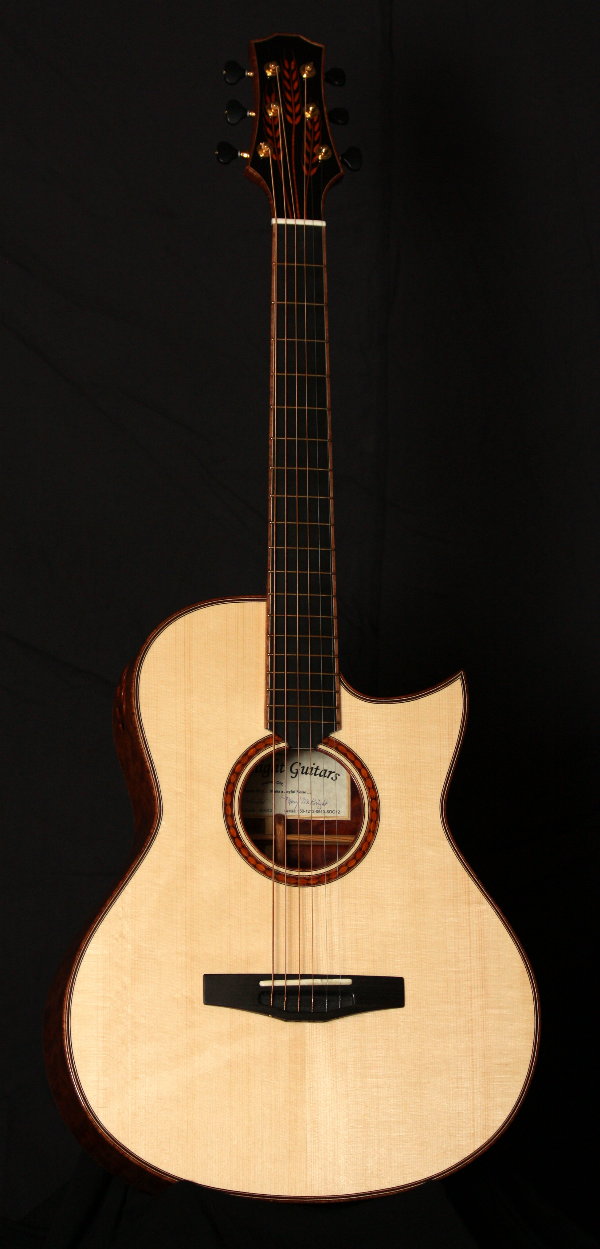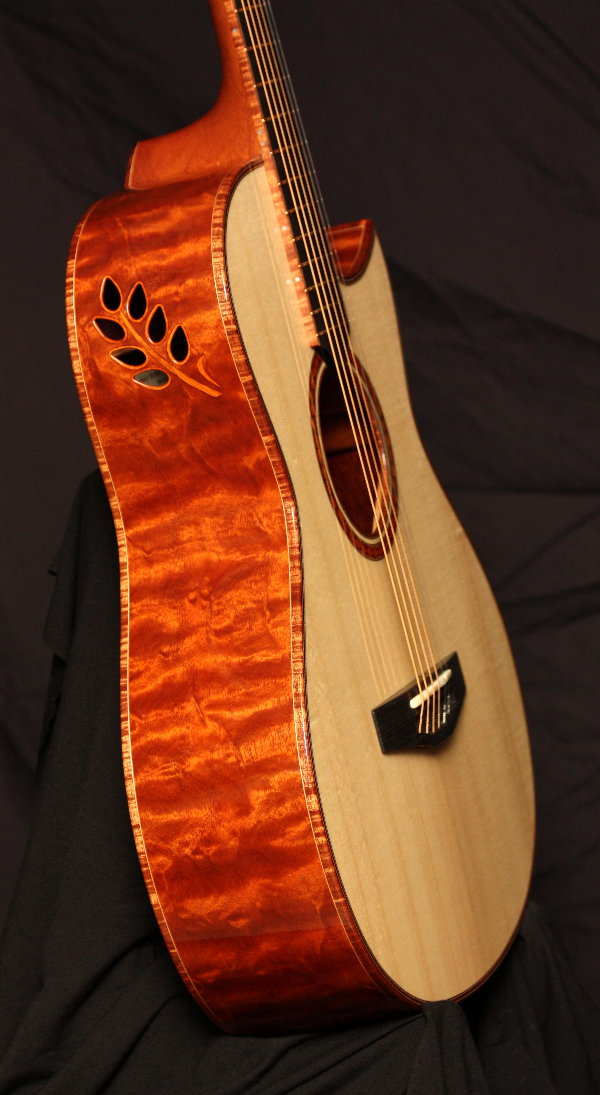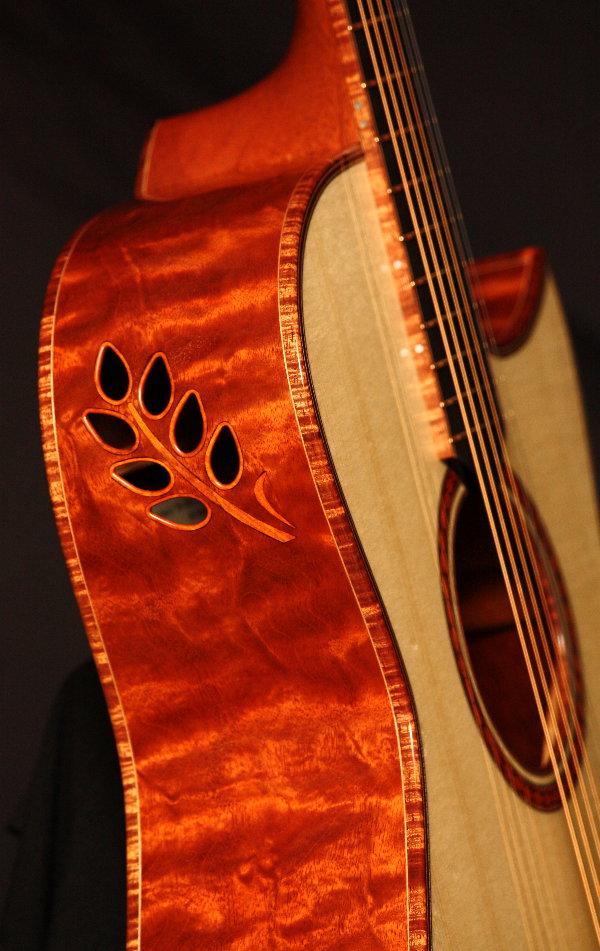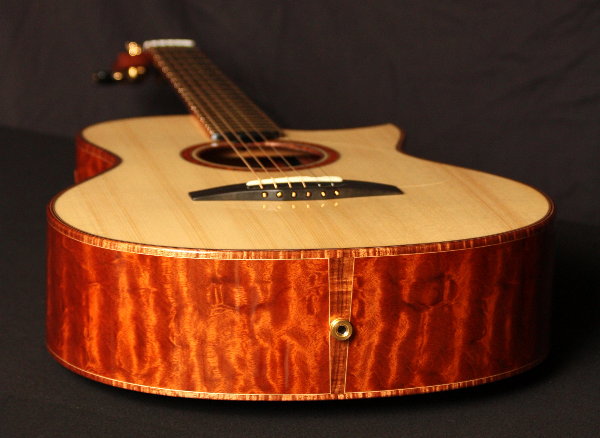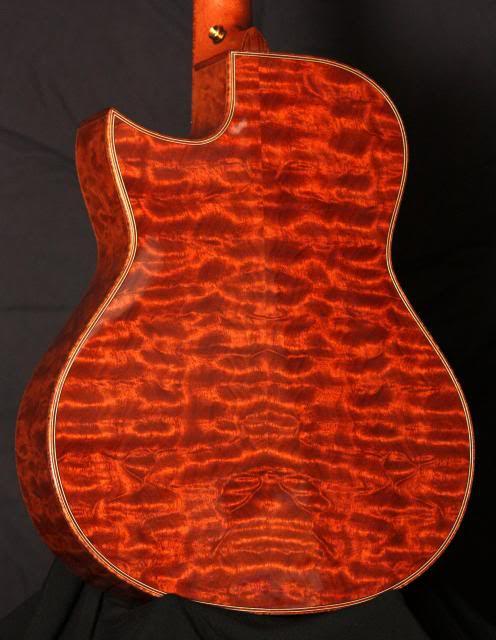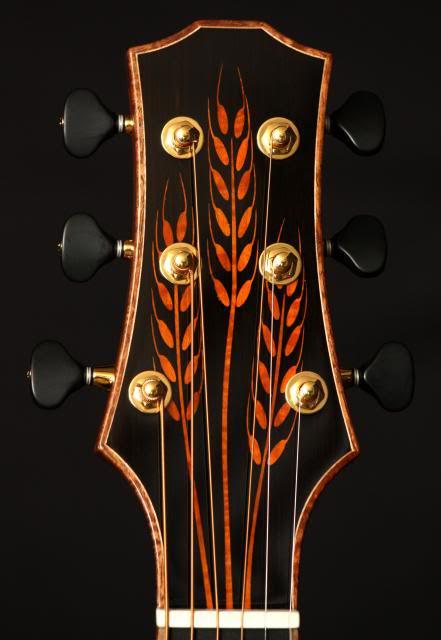
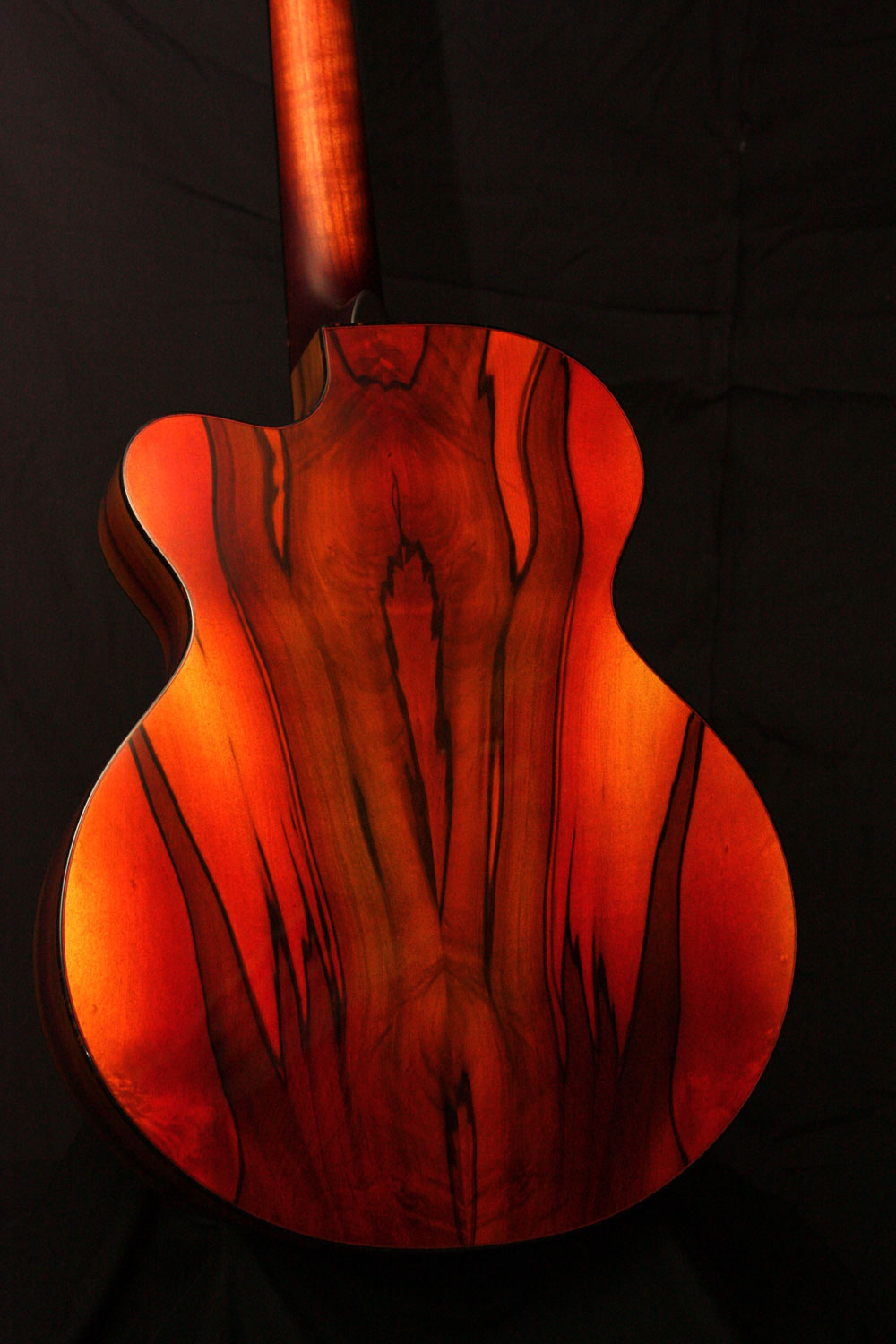
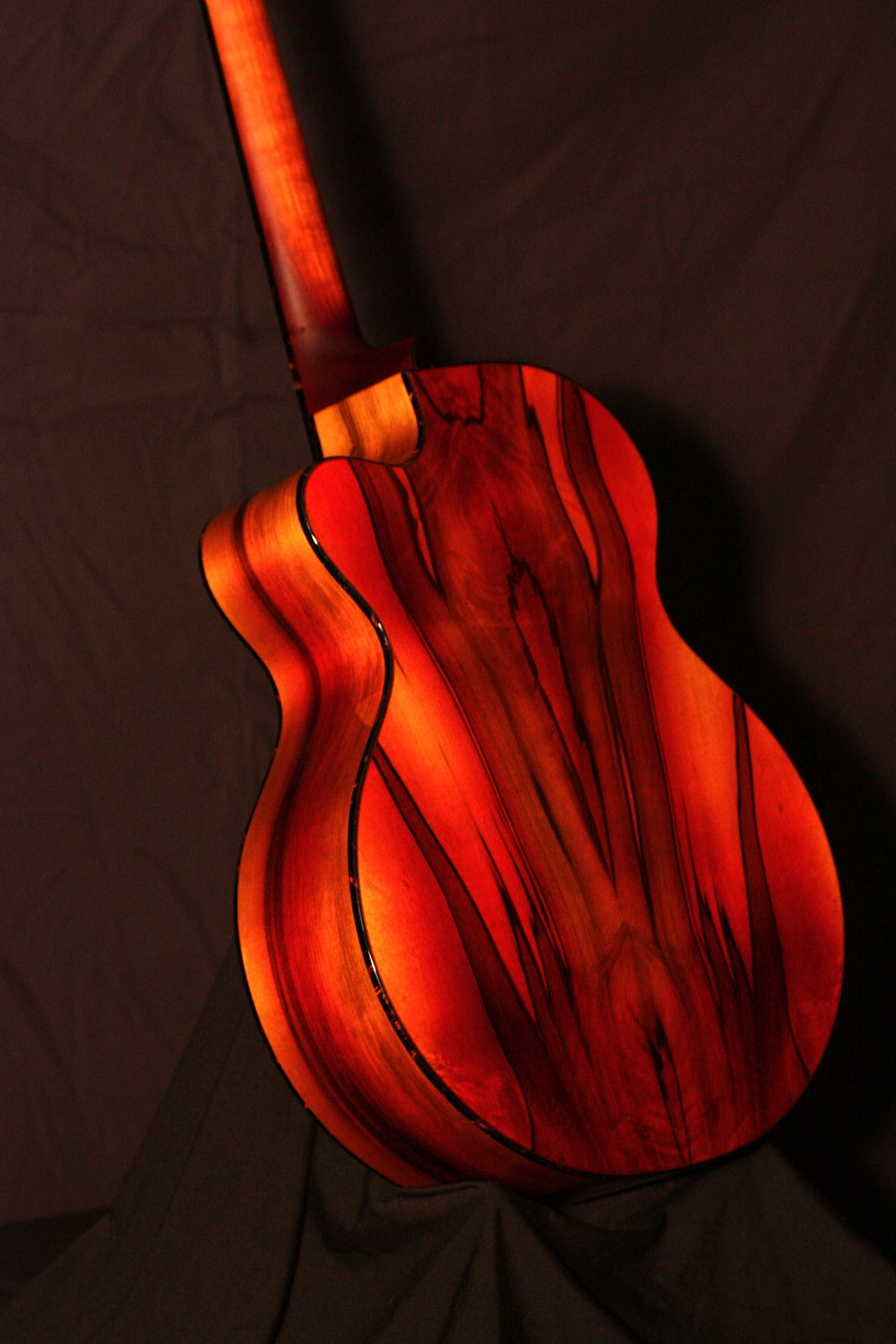
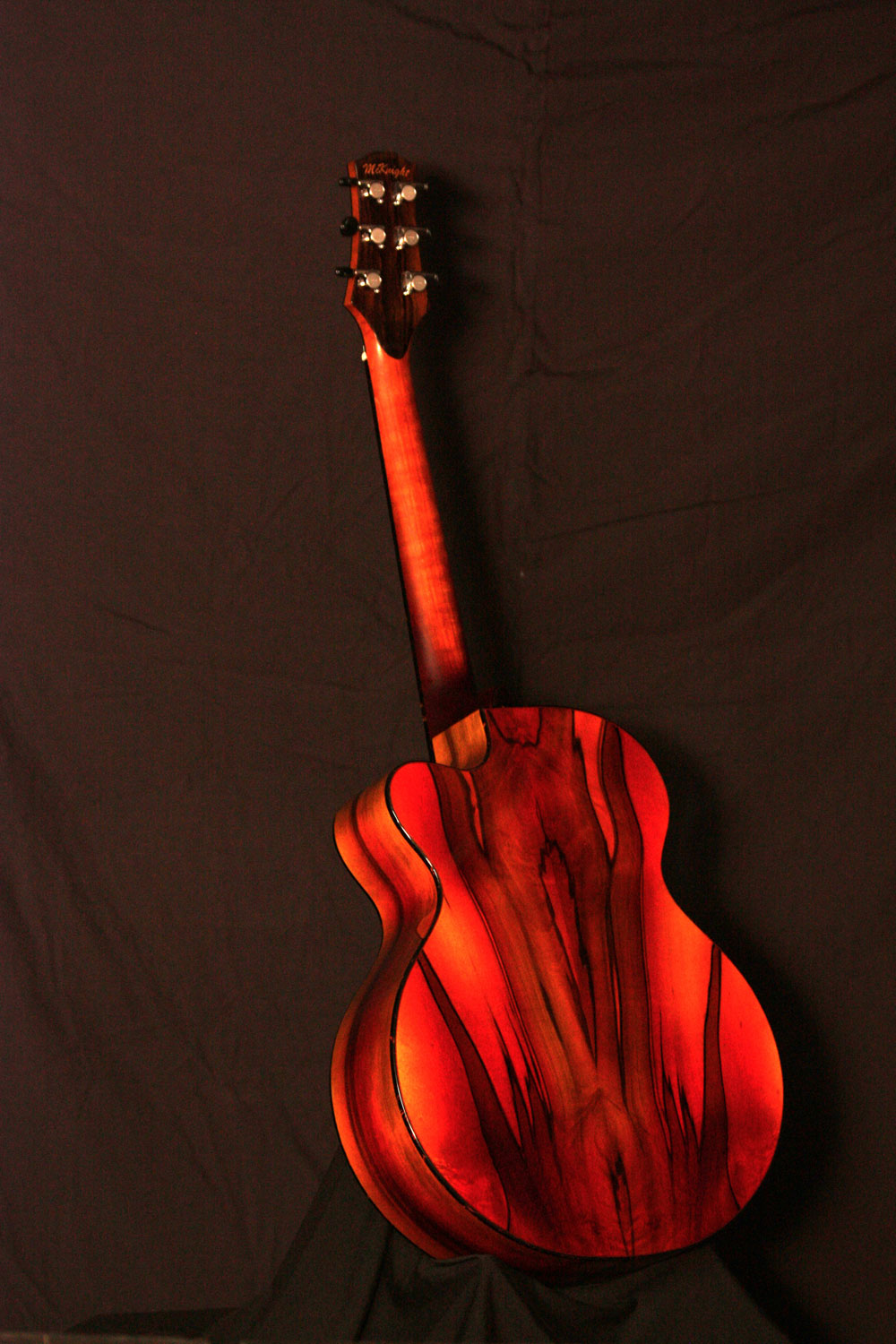
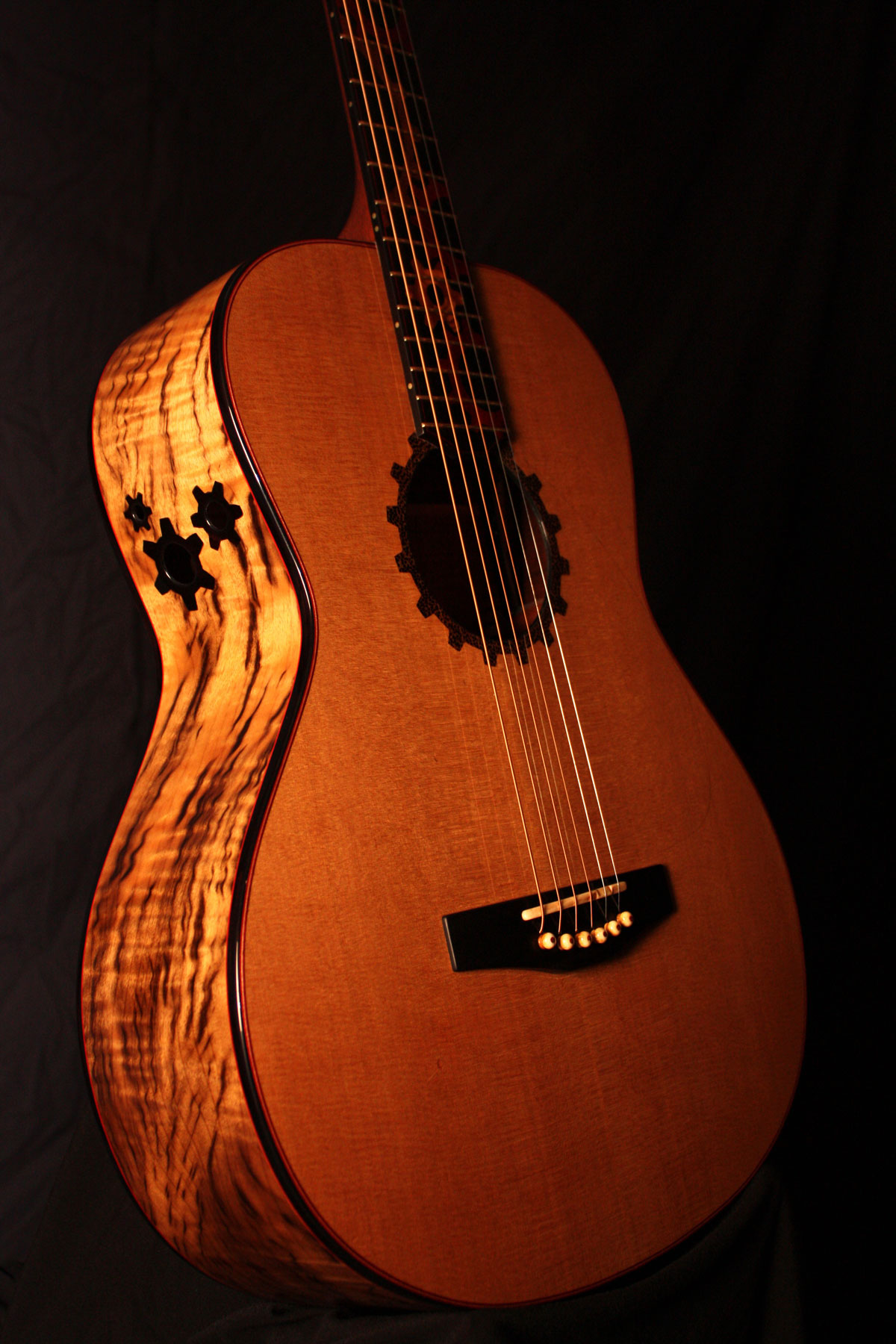
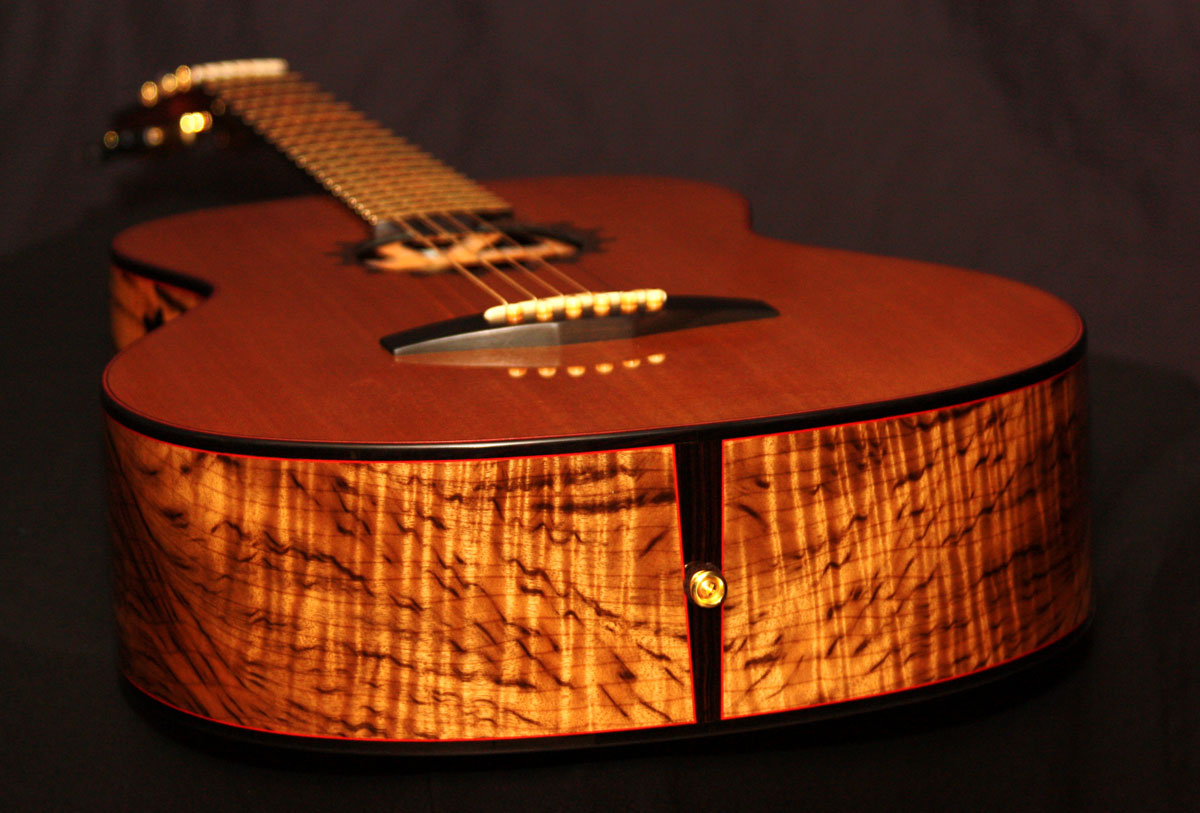
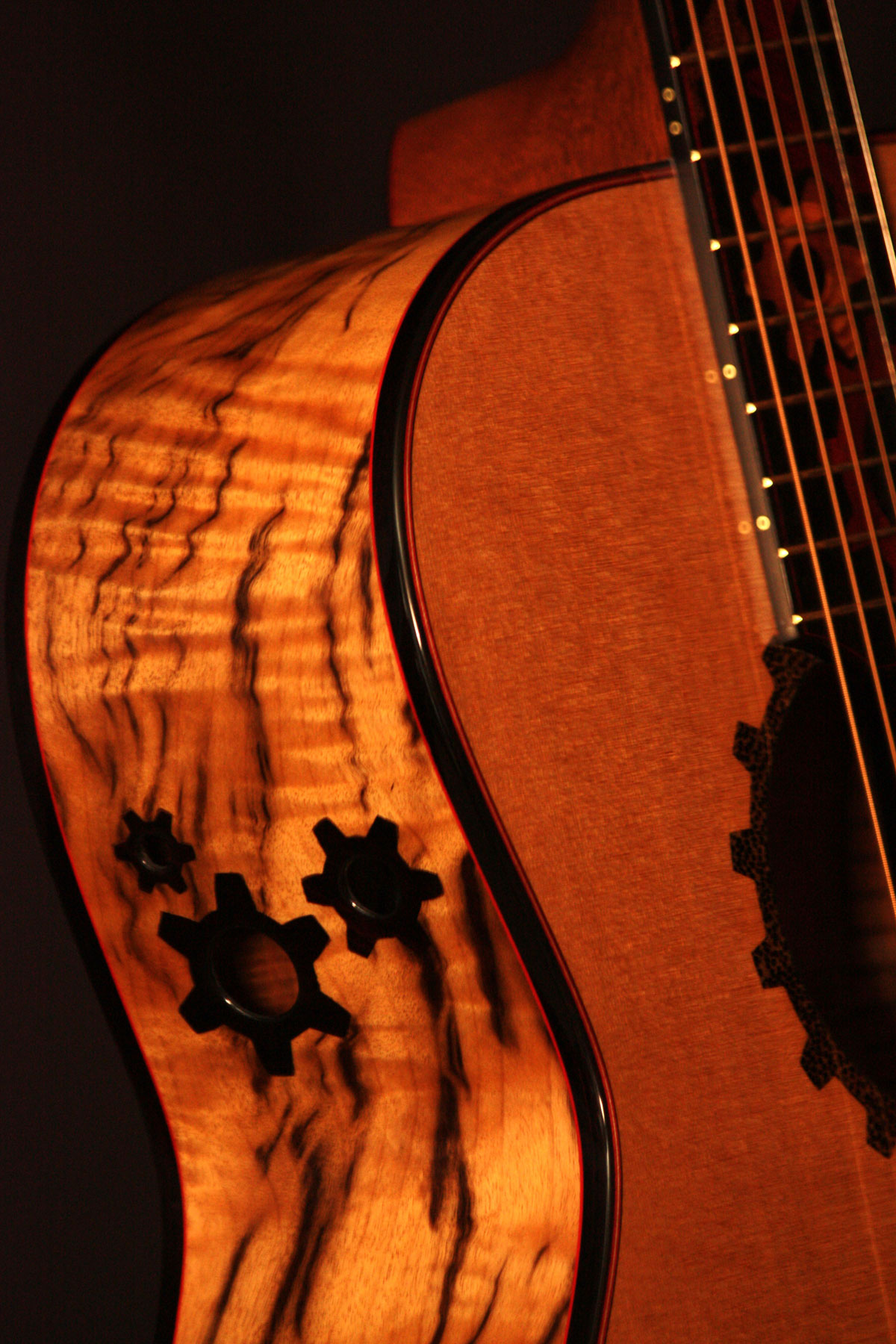
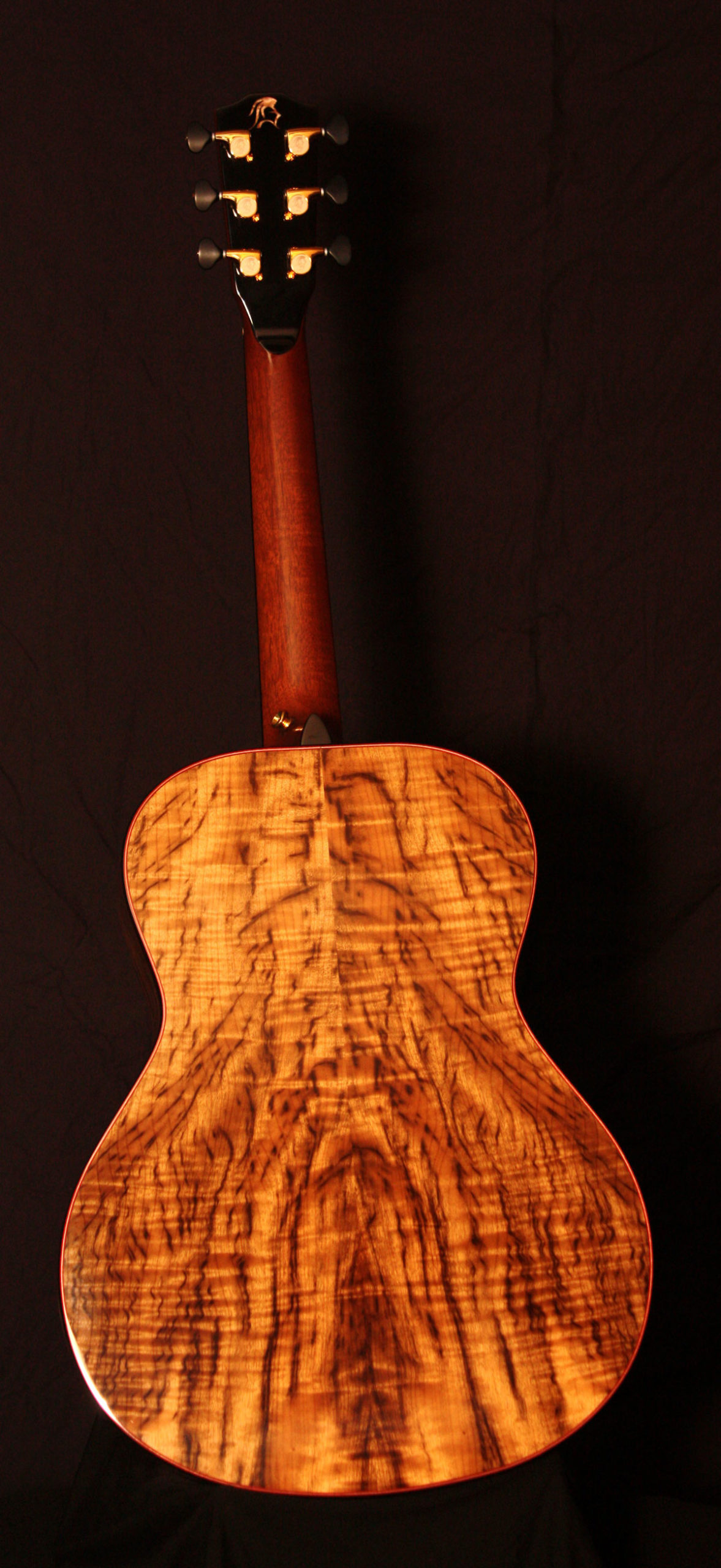
Mary started the design with a unique set of Tasmanian Black Heart Sassafras back and sides which had this wonderful natural flame pattern
in the wood. It was during the fires in Australia that we built this guitar to honor and bring awareness to those friends down under who were struggling with those catastrophic losses. She wanted to use an offset side sound hole in the Alaskan Yellow Cedar top to bring the sound closer to the player without disturbing the sides with any sound port holes. Finally she asked me to shade the body to bring out the flames and my natural response was “yes dear”.
This guitar was also our prototype for our first “Re-Echo Disc”. Since the back and sides were some of the highest damping woods I’ve ever
encountered I wanted to invent a way to add more sustain to the guitar that just wasn’t possible with some more common dead sounding wood. When tap testing this wood a piece a water soaked cardboard had a more lively tap tone than this particular piece of Sassafras. So, I added a suspended spruce disc, inside the body, which acts as an additional vibrating plate. I hoped the Re-echo disc would add additional sustain and volume to the sound box. Well my experiment was a huge success and the guitar sounded fantastic and way beyond my expectations. It has sustain to the moon, faster response and increased volume. What’s not to like from a virtually dead sounding piece of wood? I have since built several more guitars with our Re-echo disc technology and all have out performed our expectations!
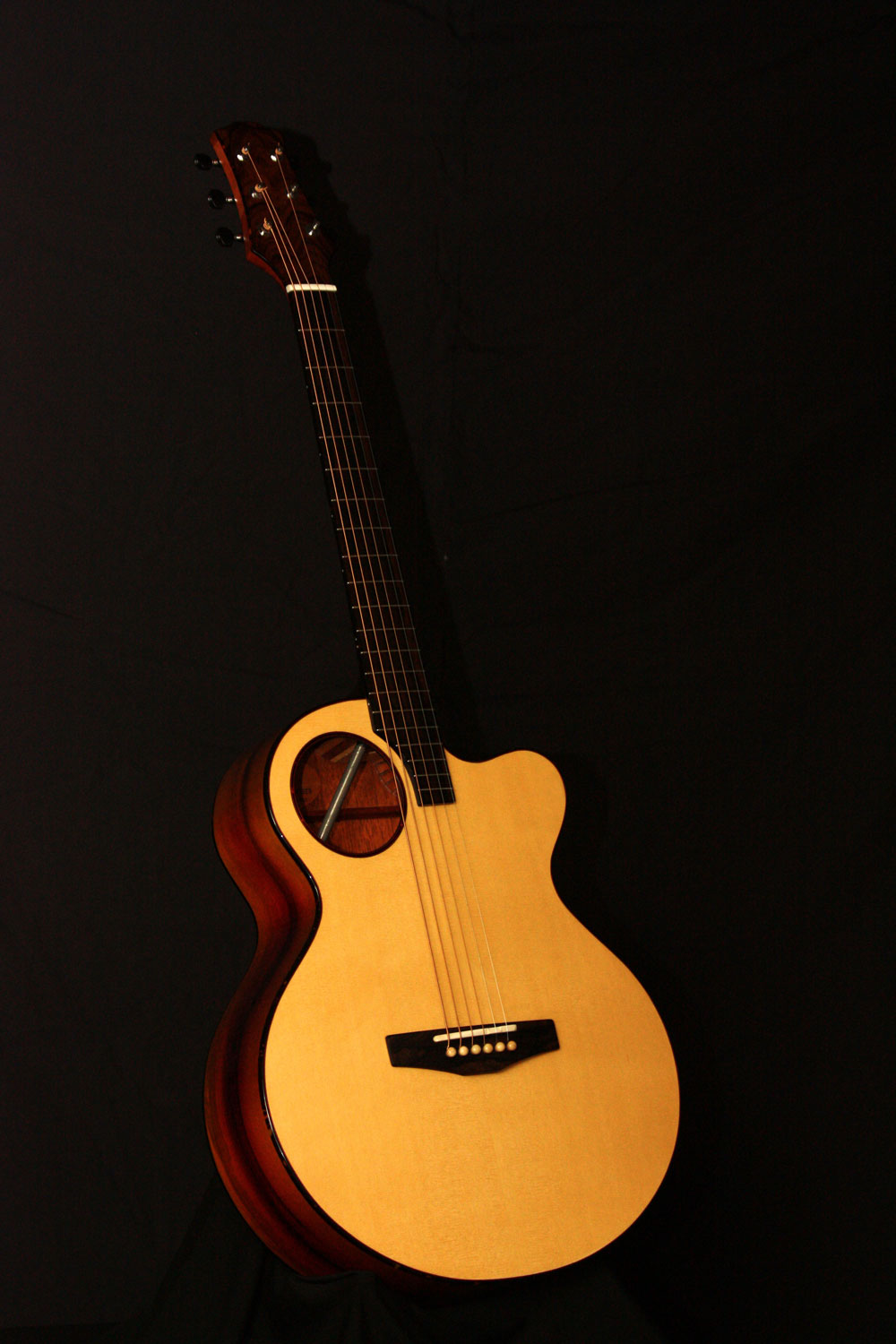
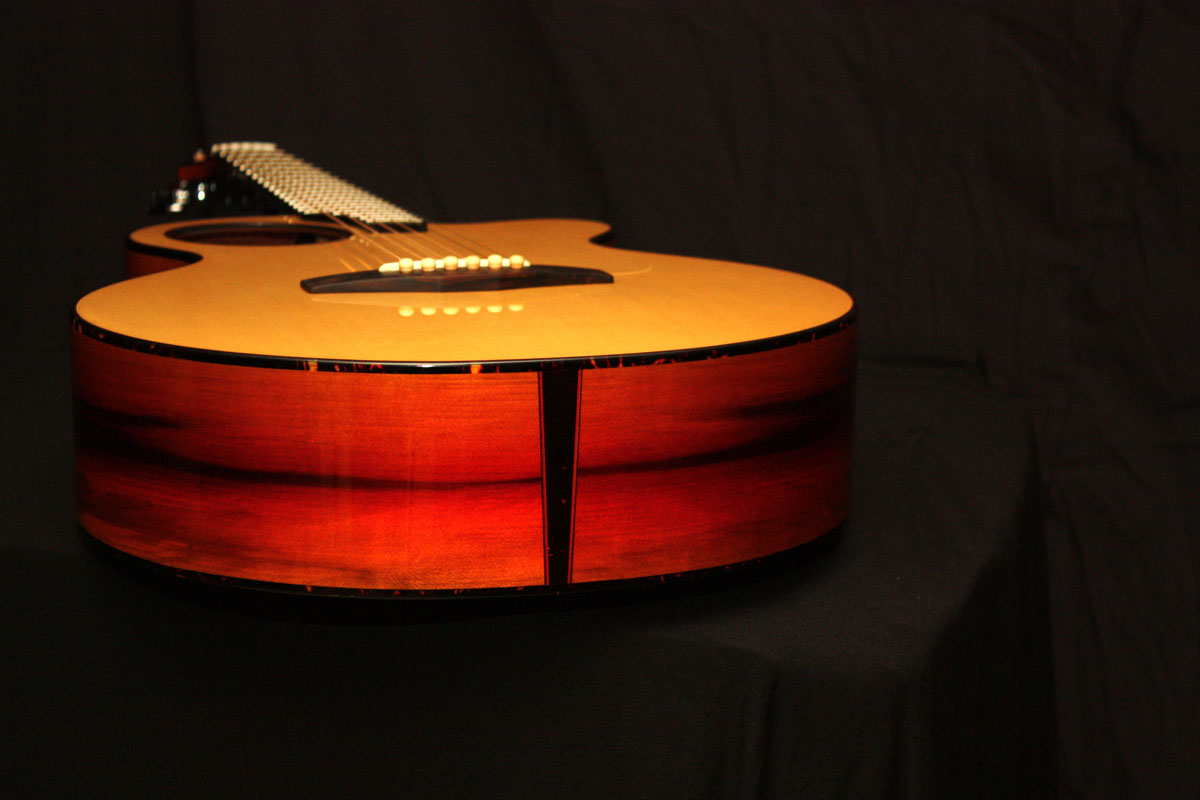
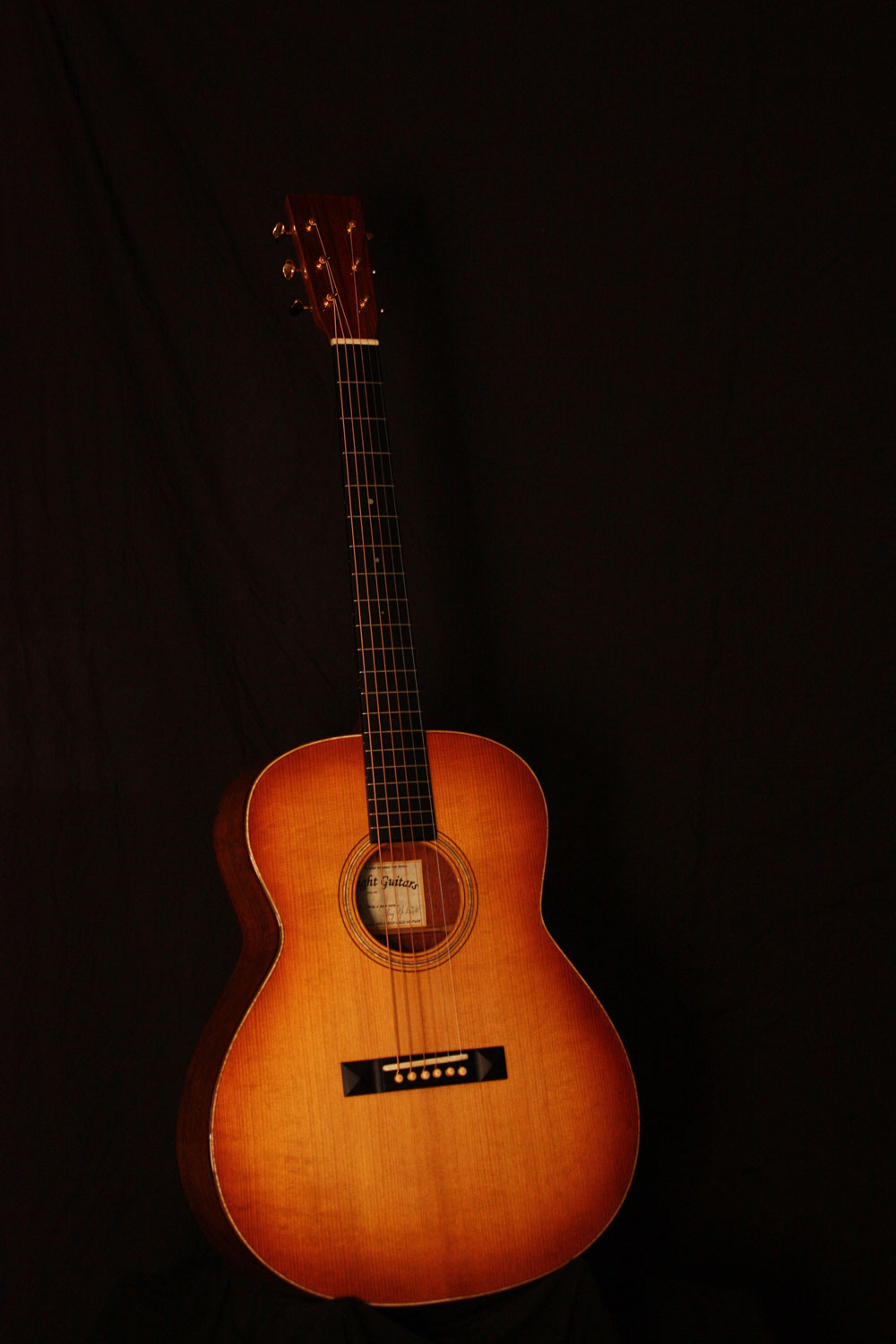
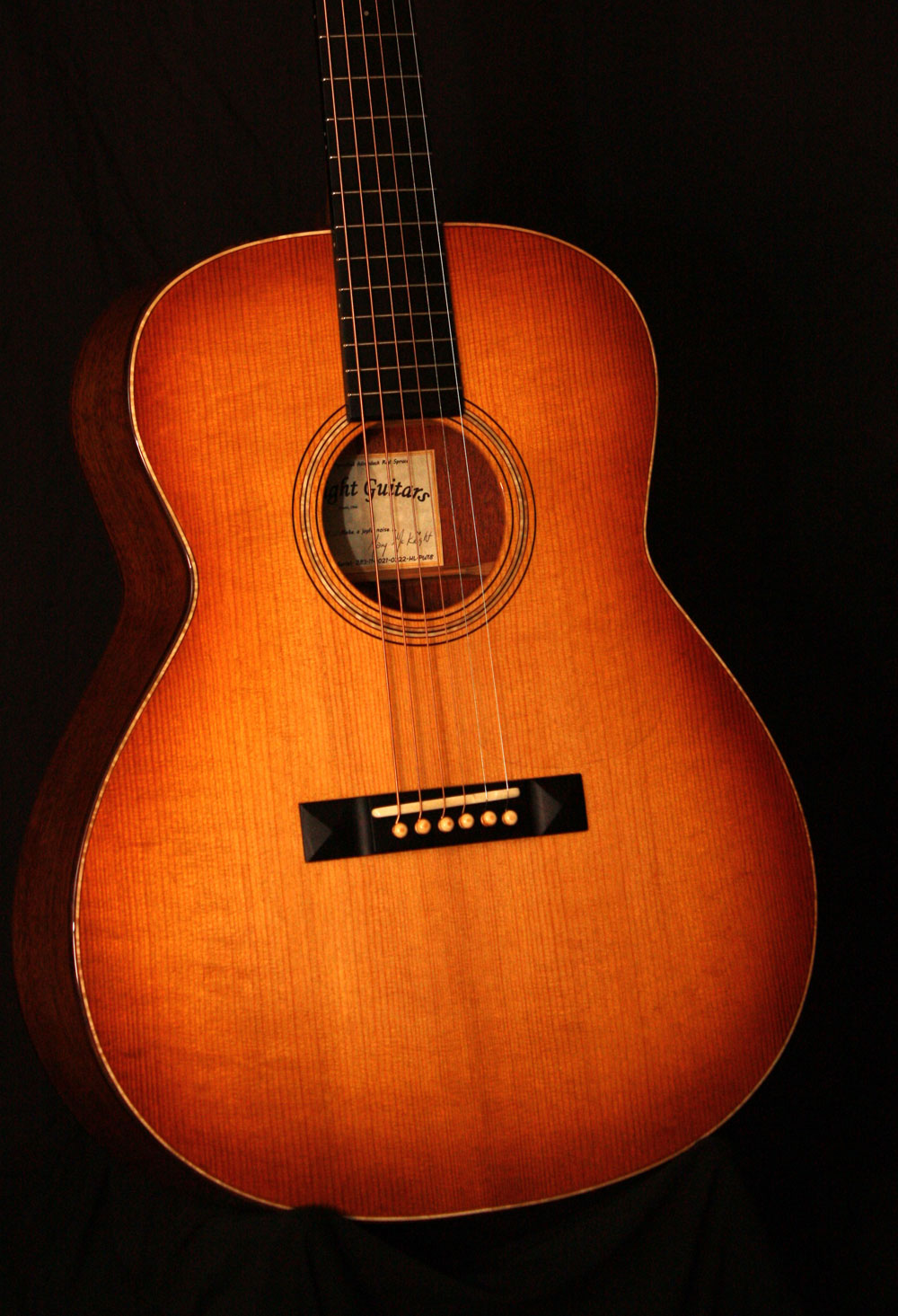
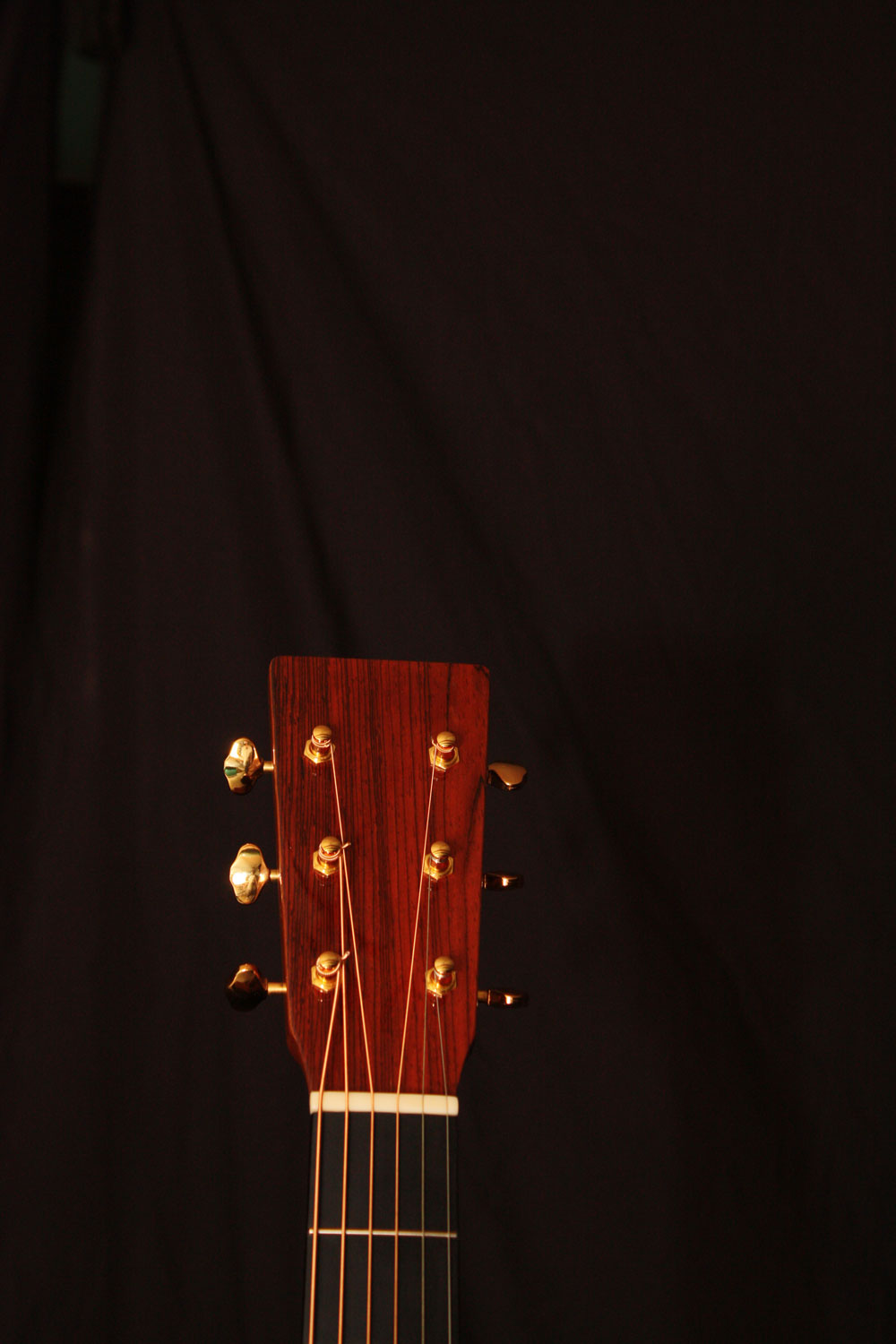
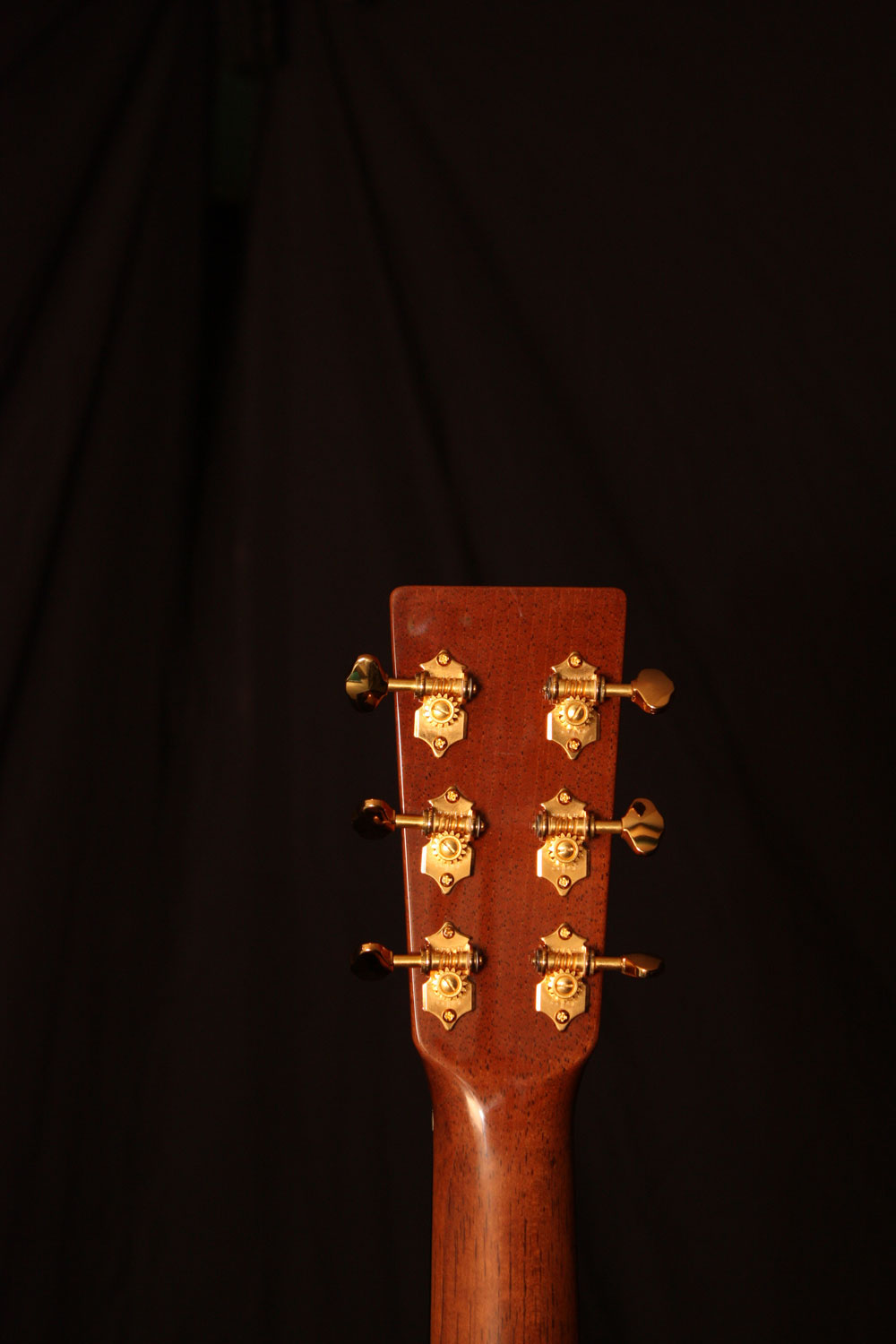
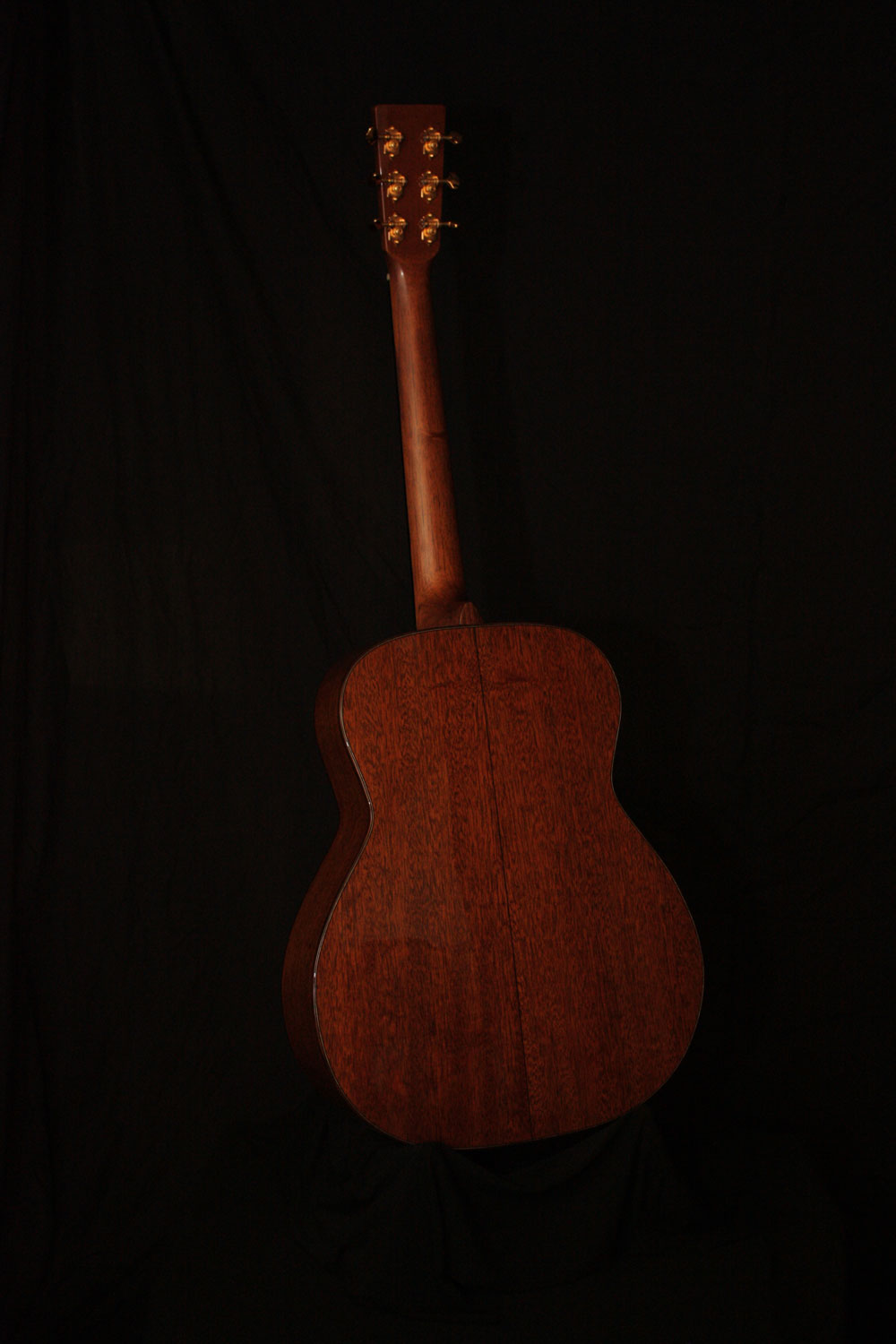
This is our tip of the hat to some of the great pre-war era OMs that so many players seek but only few can afford. We started with our
HighLander body of genuine Honduras Mahogany and paired that with a torrefied Adirondack Red Spruce top. The sides and back are single ply
and much thinner than todays over built guitars and the top being torrefied or baked in a special oven artificially ages the tone giving
the player that dry vintage tone that so many players love in those wonderful pre-war guitars. This model is simple in its design yet
extremely responsive because its built right and light in all the right places. This guitar weighs in at a staggering 3 pounds which you won’t find in any of the current factory reproductions. This model offers that great vintage tone, power, responsiveness and playability on day one without having to wait 80+ years.
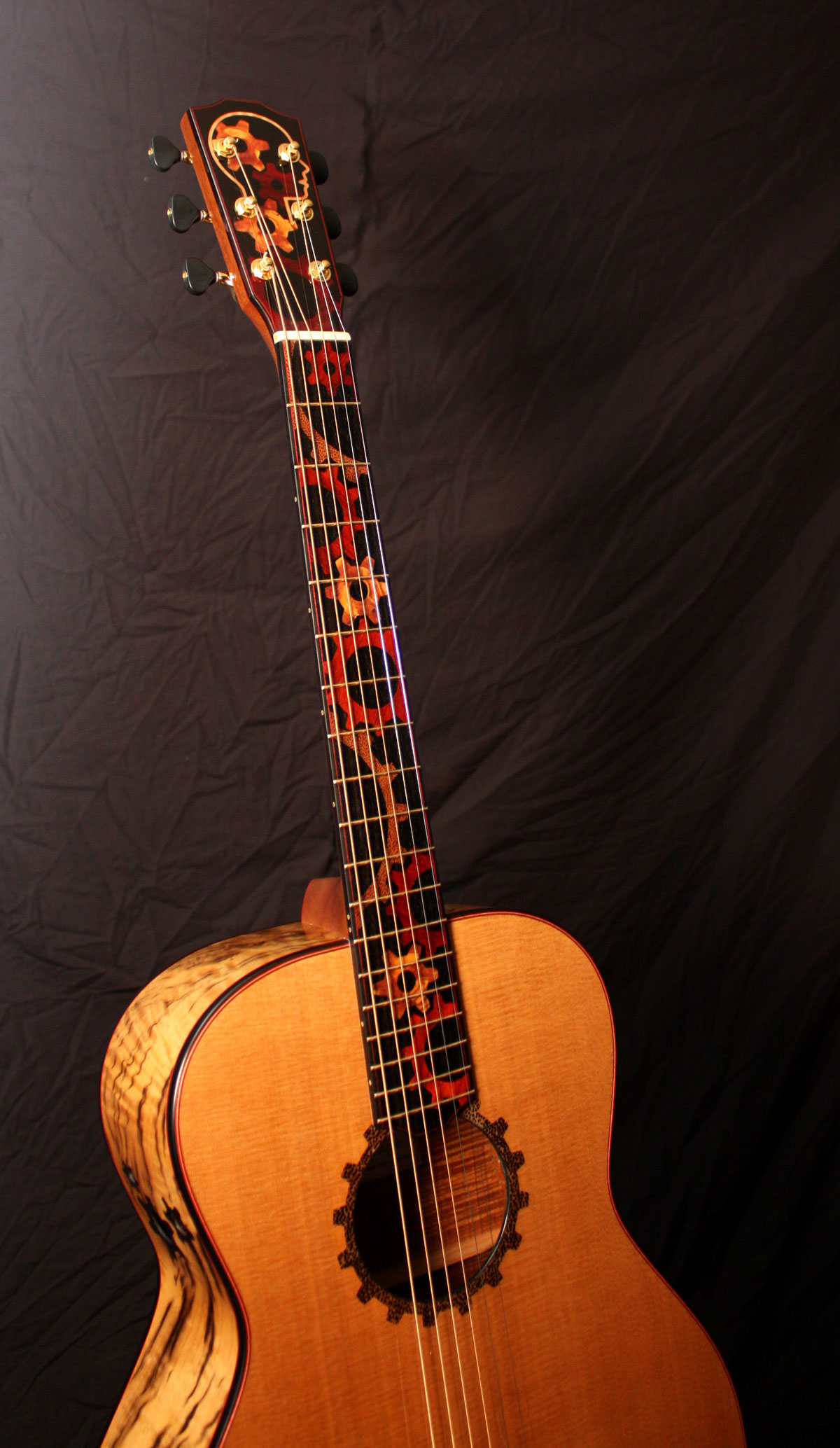
After seeing and playing the first “Gear Head” version Doc wanted something visually similar but in a slightly larger body. He fell in
love with the size and tone of the Isaiah SDG guitar which was made from Australian Blackwood and a Cedar top. However, Doc’s wife Caitlin fell in love with a unique set of Tasmanian Tiger Myrtle back and sides so we assured them that we could satisfy both their desires by building a box within a box using Catlin’s Tiger Myrtle back and sides on the exterior with Doc’s Australian Blackwood on the interior by utilizing our own “Hollow Back” design and double sides. We were able to give Doc the tone he wanted and the visual eye candy Caitlin had fallen for plus adding lots of “Gears Gone Wild” inlays throughout.
Doc’s aggressive string attack could easily overpower the single Cedar top of the Isaiah guitar so we suggested using a Cedar “Double Top” to give him a much wider dynamic range and seemingly endless headroom. Based on his feedback I think we satisfied them both.
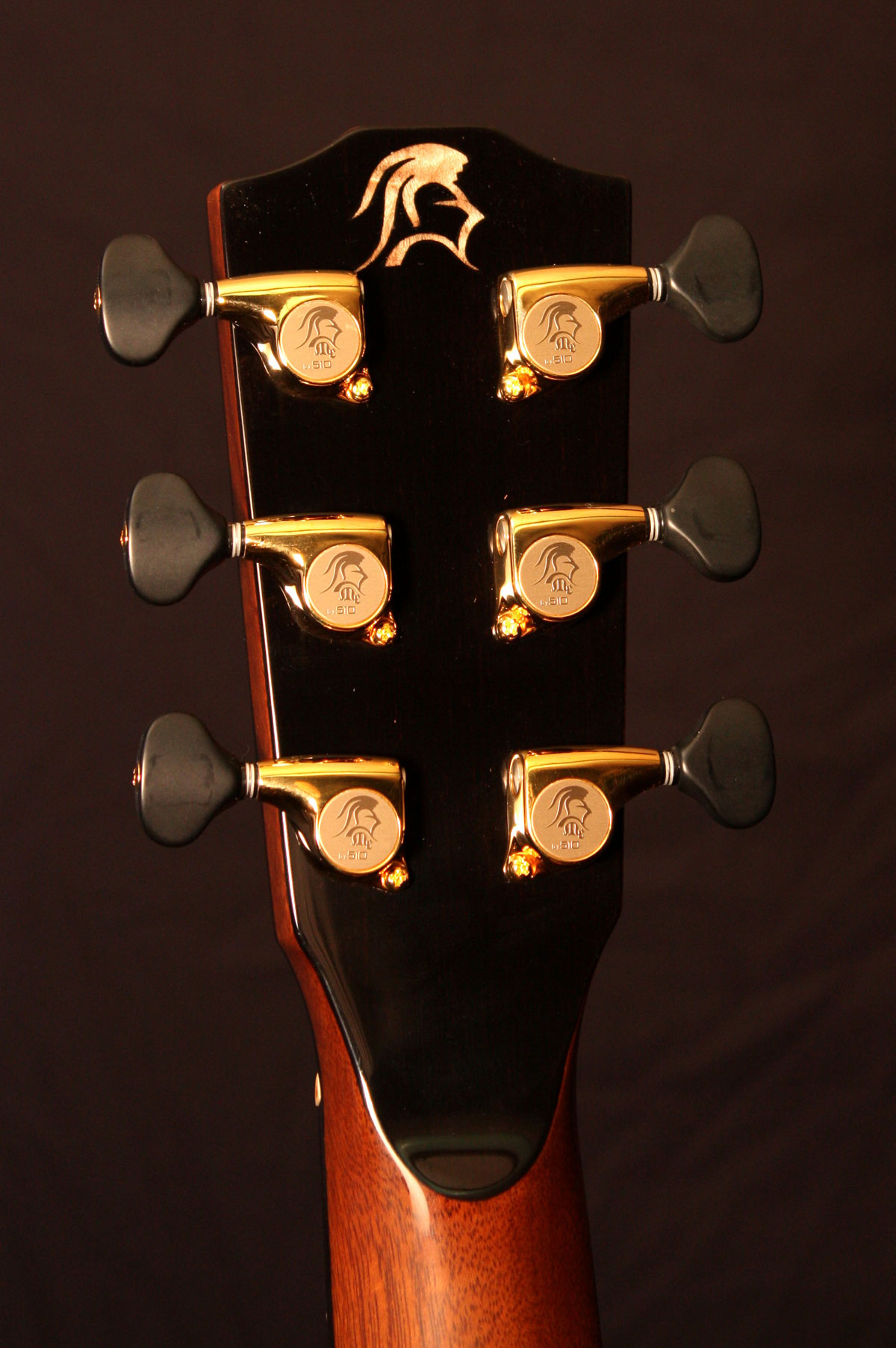
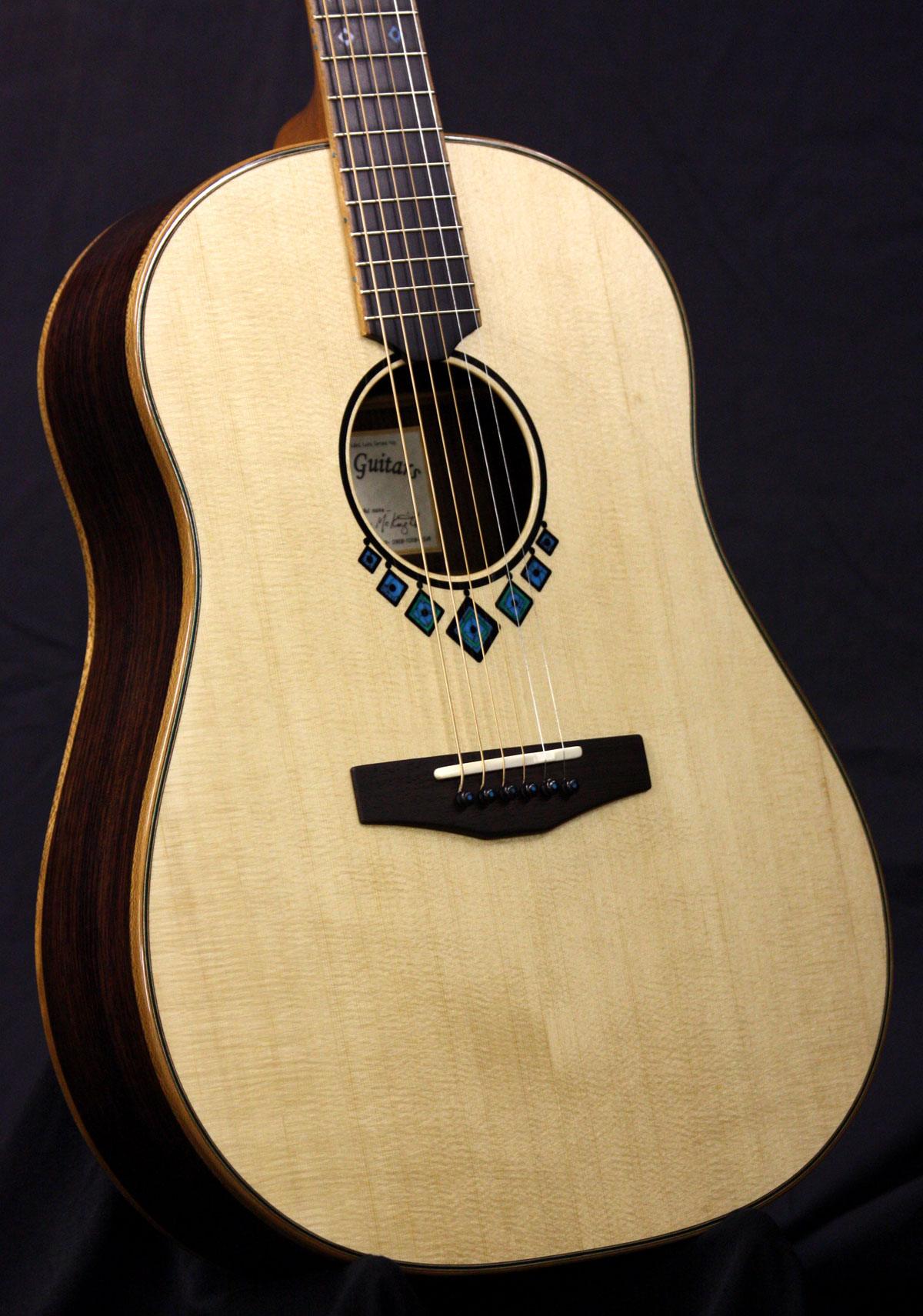
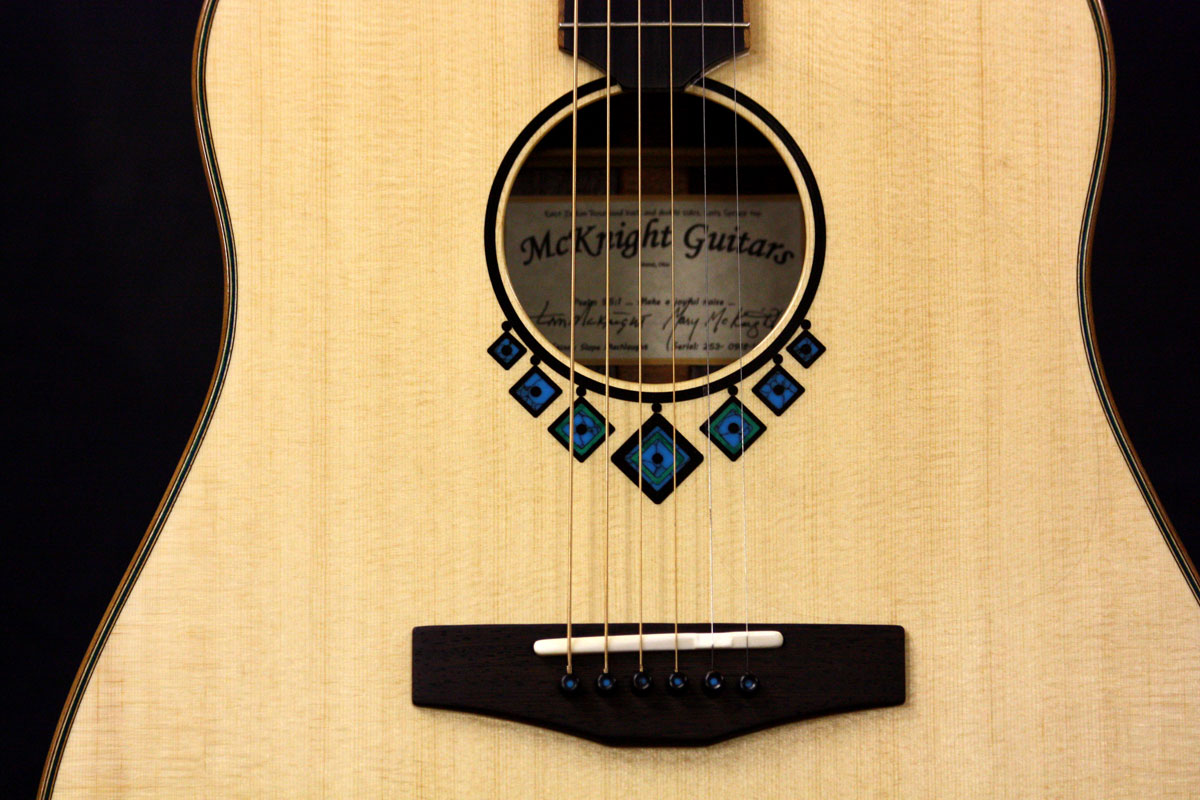
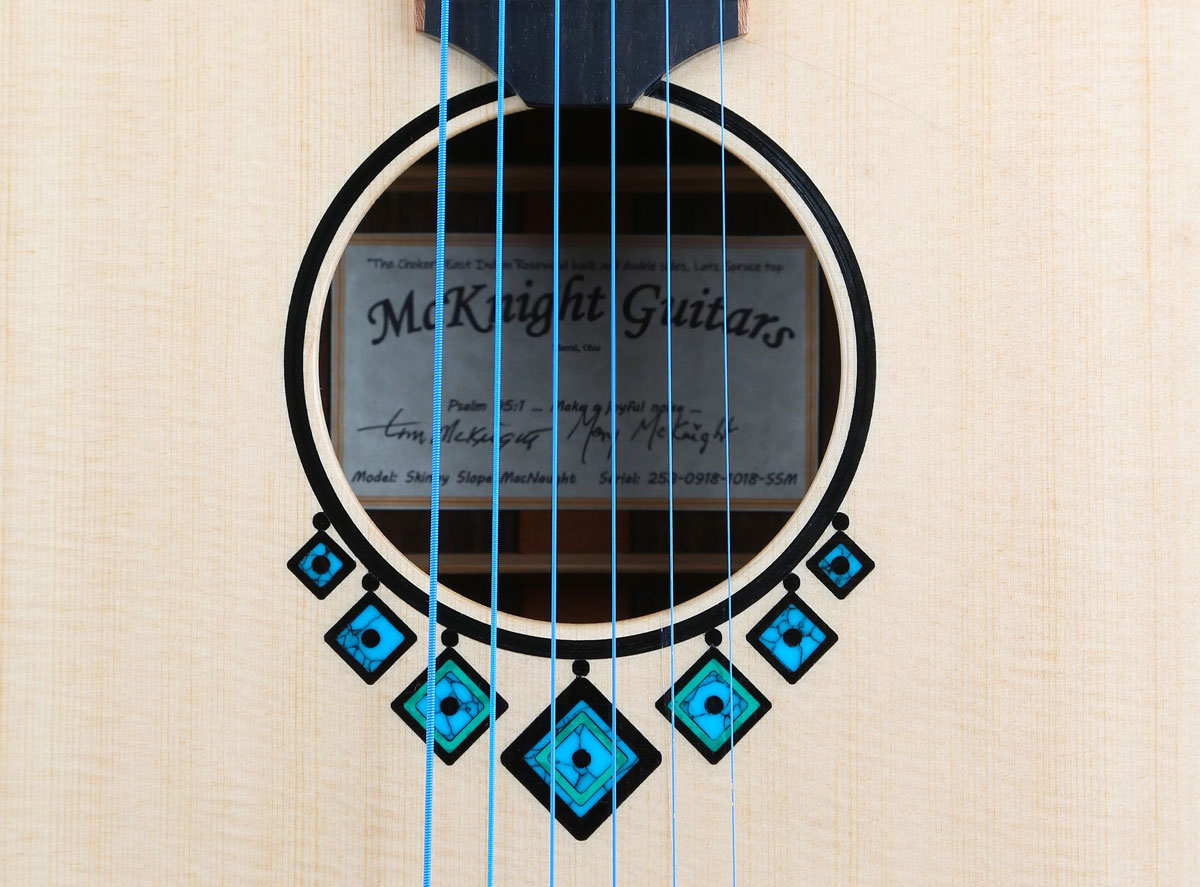
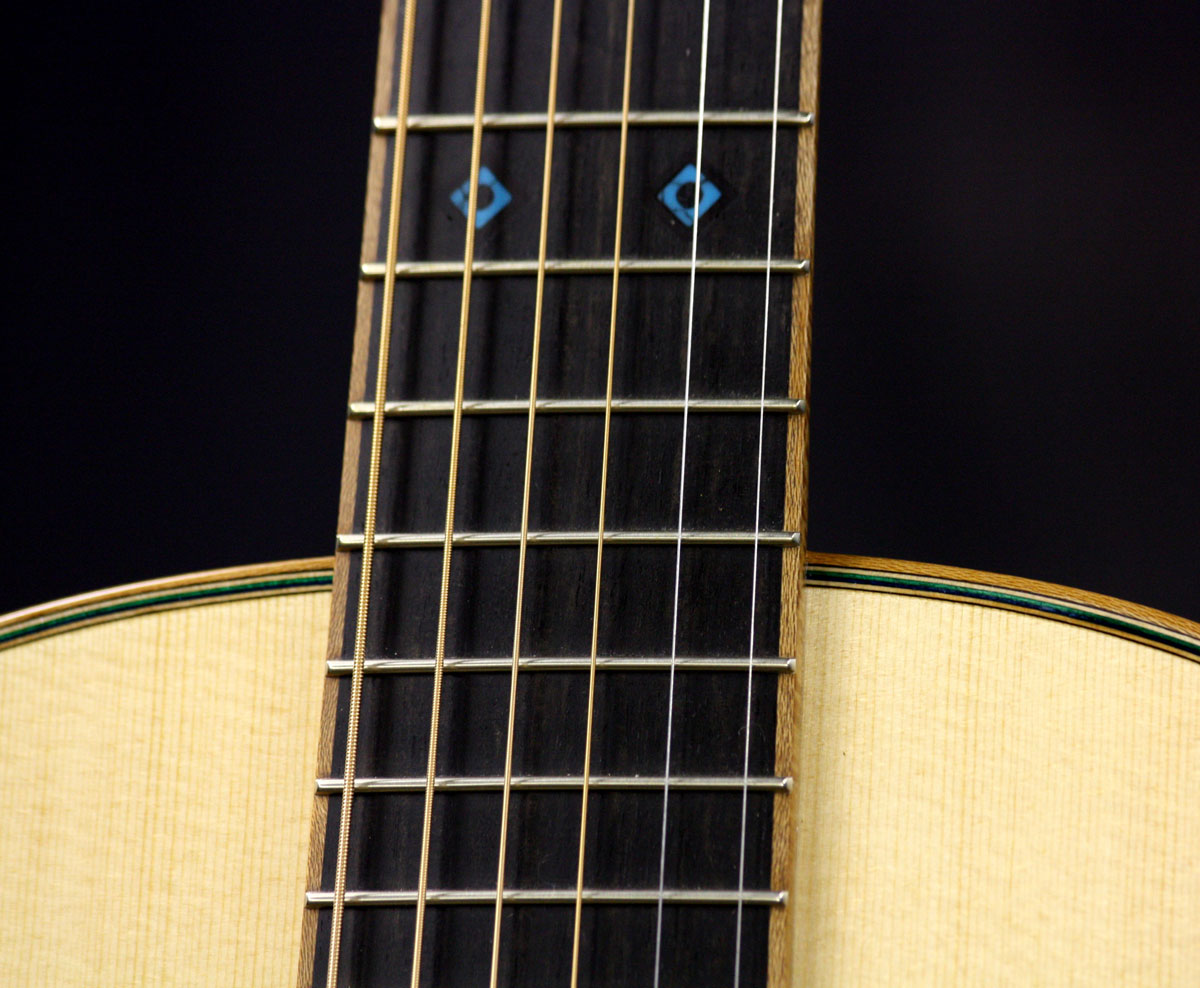
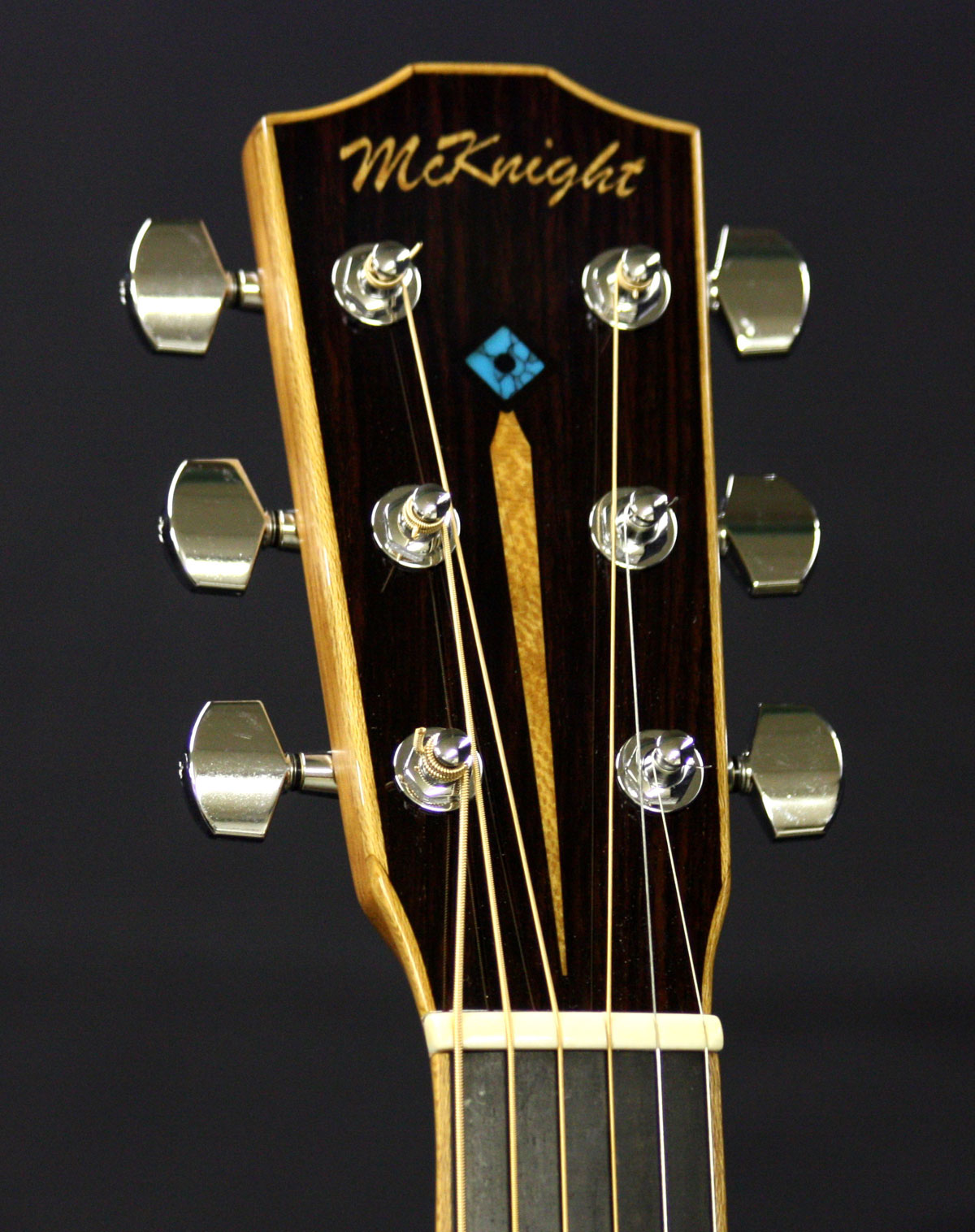
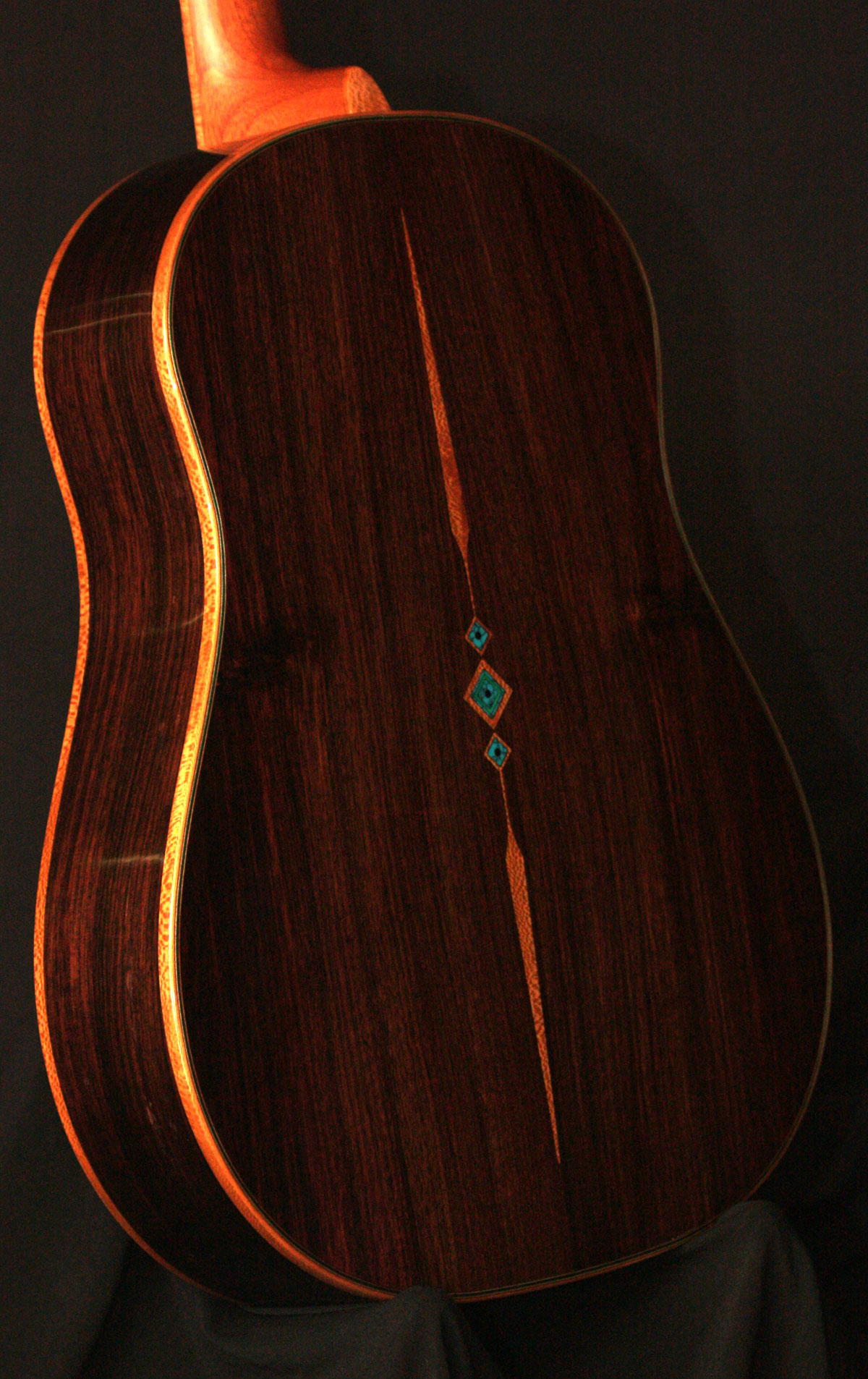
Mary designed the theme of this guitar around a “choker necklace” she used to wear when she was in her teens. The guitar body is our “Skinny” (3″ deep) Slope MacNaught of E.I. Rosewood, Lutz spruce top with Turquoise, green malachite, Ebony and Sycamore inlays.
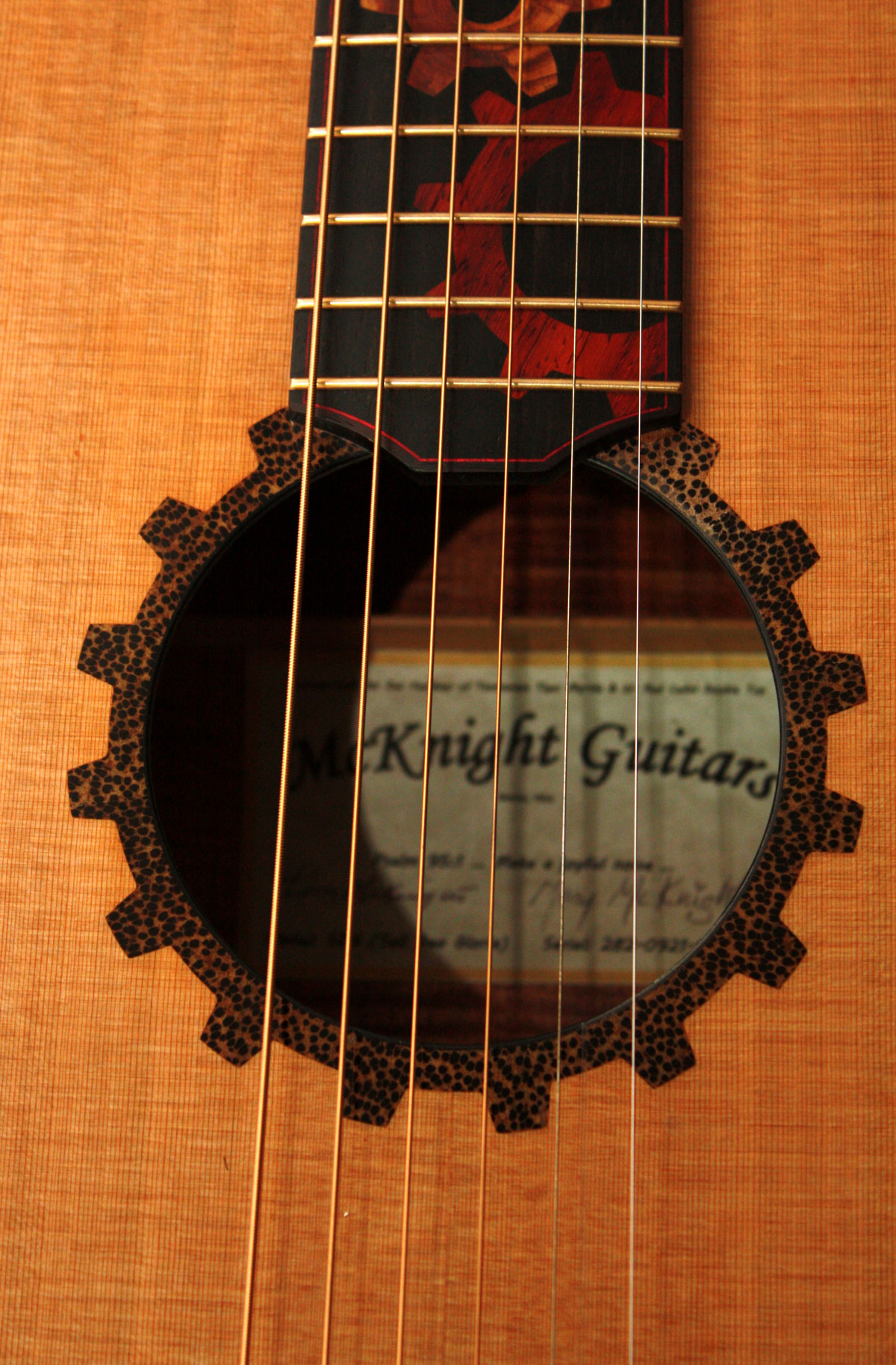
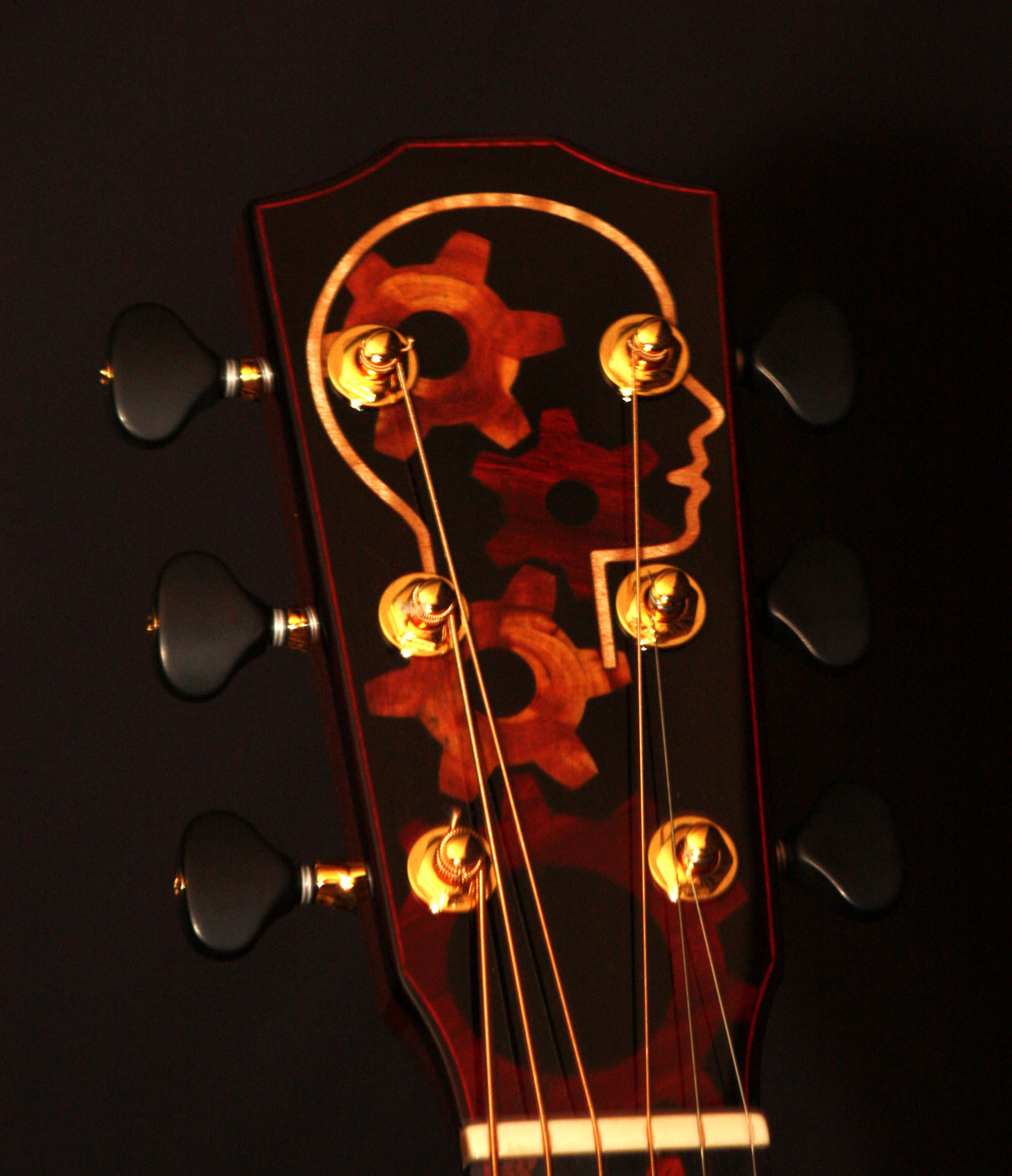
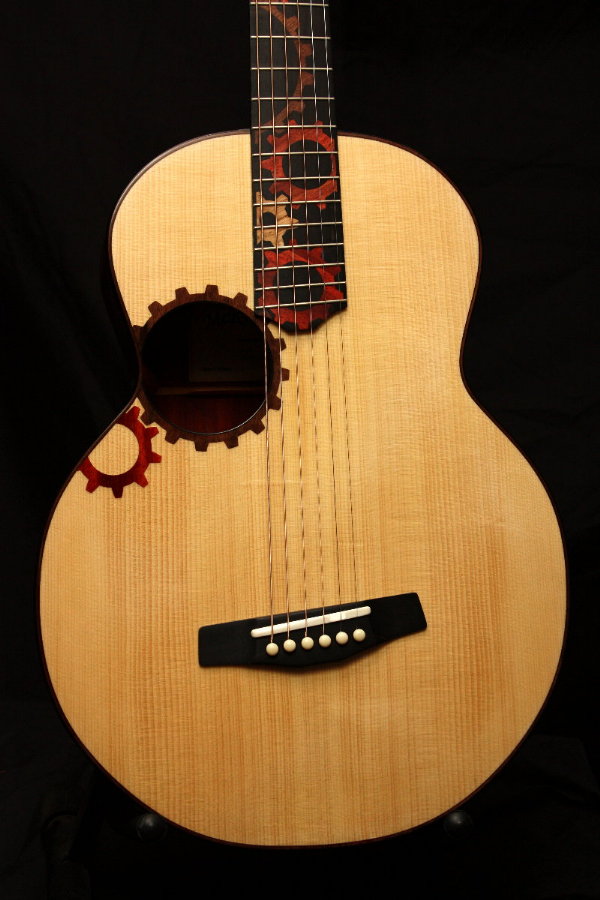
The “GearHead” Guitar was designed by Mary. She woke up in the middle of the night and told me she had “gears” on her mind. I told her to sketch it out and we would discuss it in the morning. After much deliberation this is what we came up with: Skeeter body, Adirondack Red Spruce top with offset sound hole, African Padauk back and sides, dual scale lengths of 25.4″ and 24.9″.
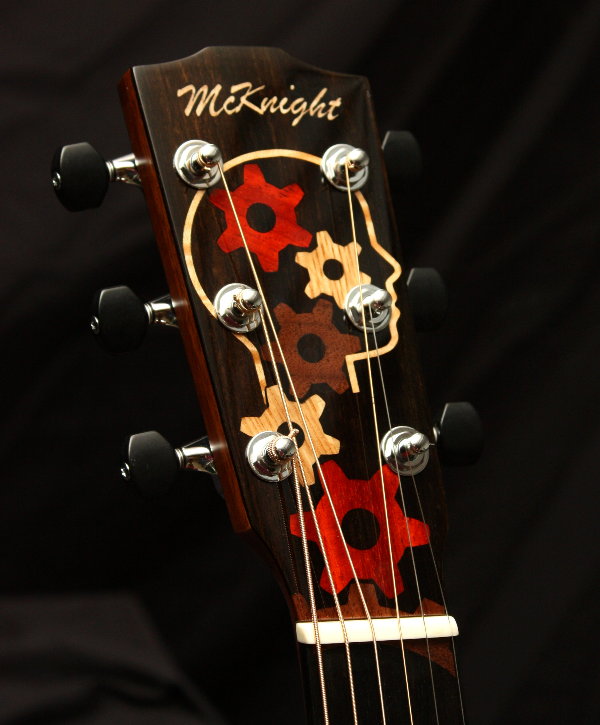
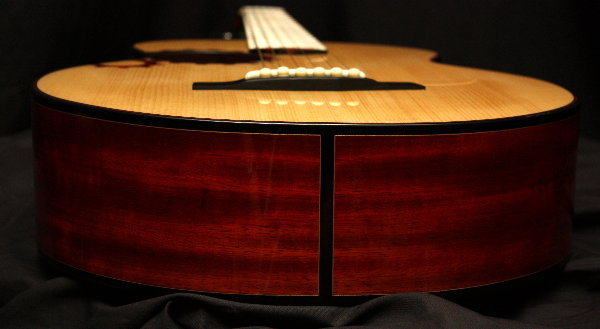
The Diamond Guitar was designed by Mary to commemorate our 25th wedding anniversary. It’s based on our popular MiniMac body which uses a unique set of 1940 Brazilian Rosewood, our own “hollow-back” design and “double-sides” as well as an Italian Spruce “Double-top”.
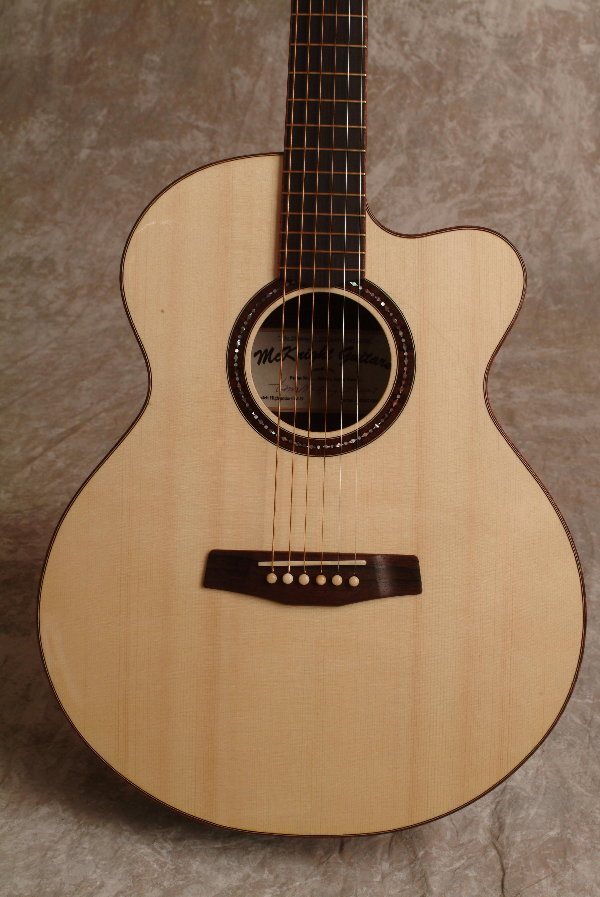
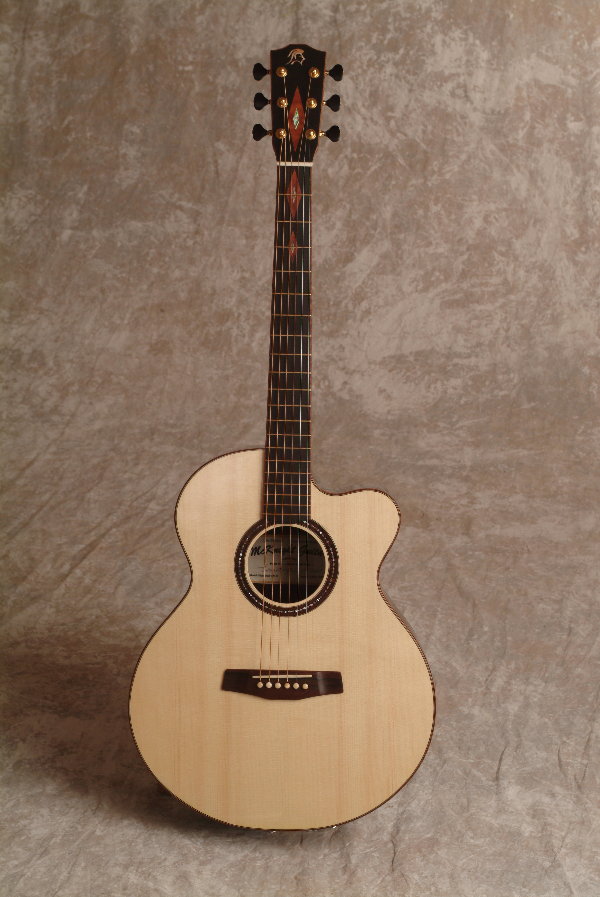
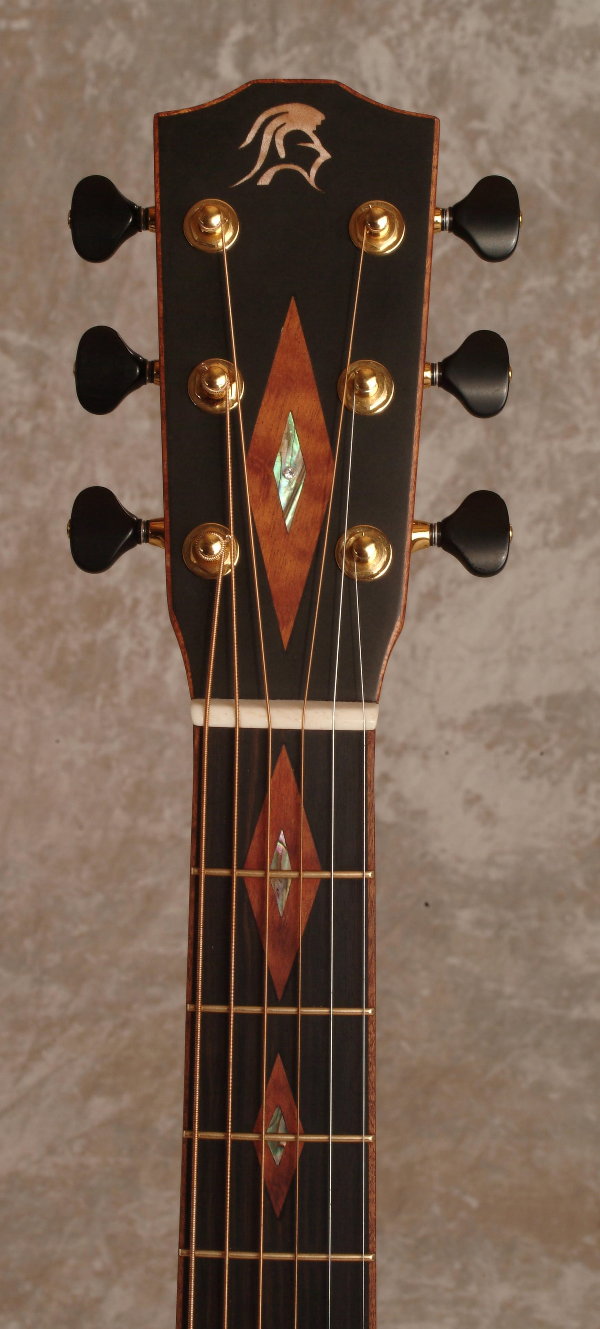
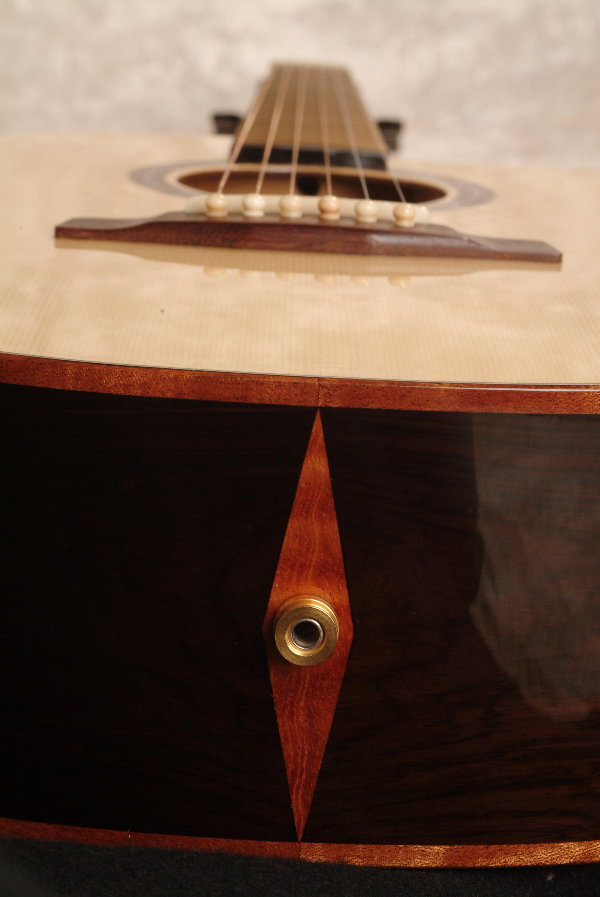
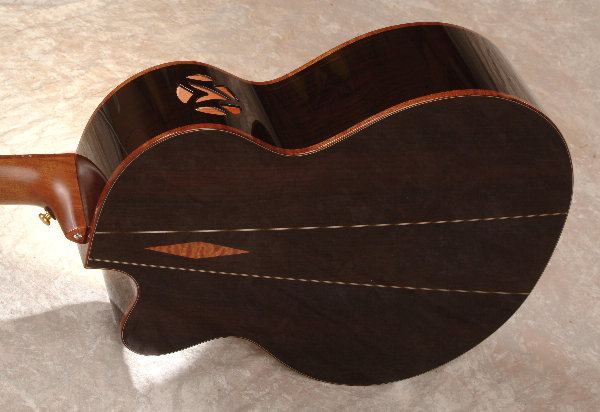
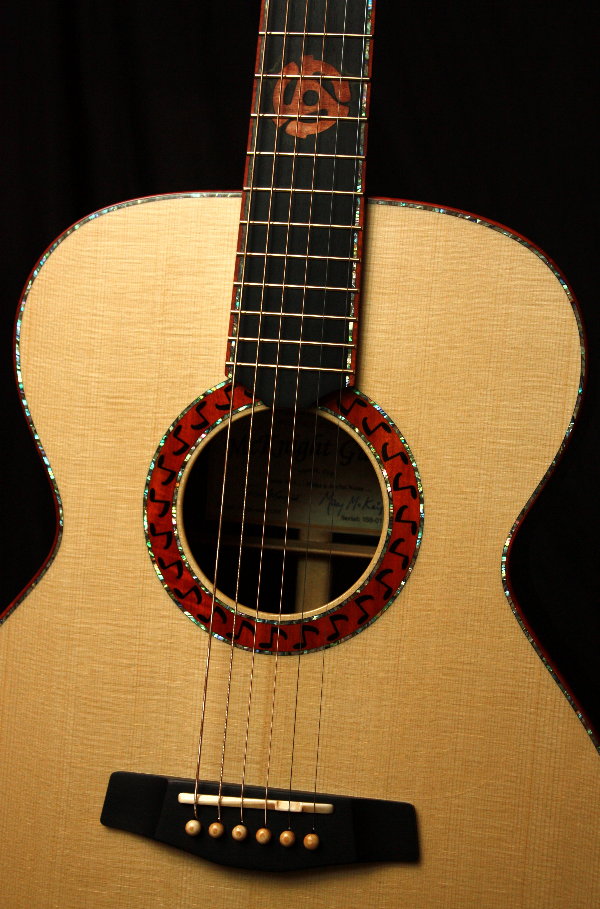
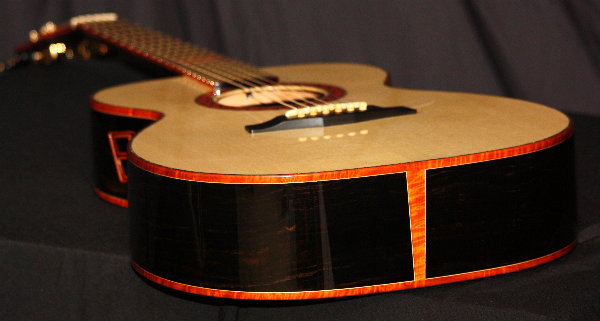
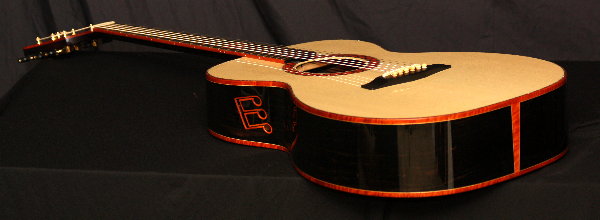
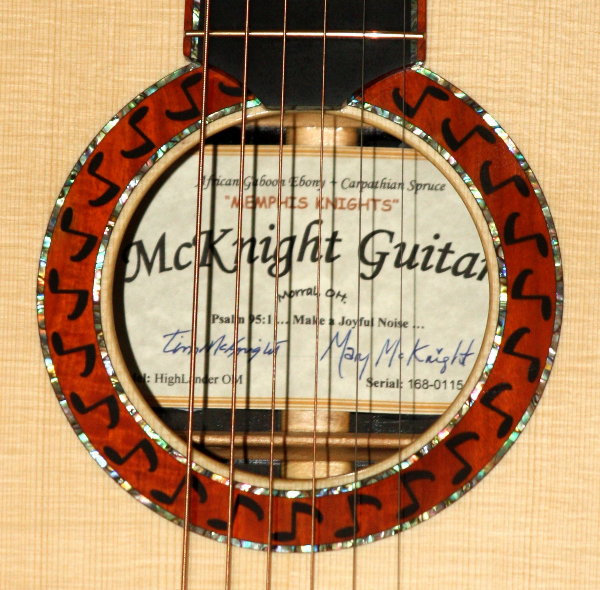
We wanted to use a rare set of African Gaboon Ebony we have had curing for well over 20 years in our climate controlled wood room. This perfectly quarter sawn set was only large enough for a HighLander OM body. We combined the Ebony with a master grade Carpathian Spruce top. The wood combination was magic. Bindings and rosette are Brazilian Pernambuco wood. Peg head, fingerboard and bridge are Ebony as well.
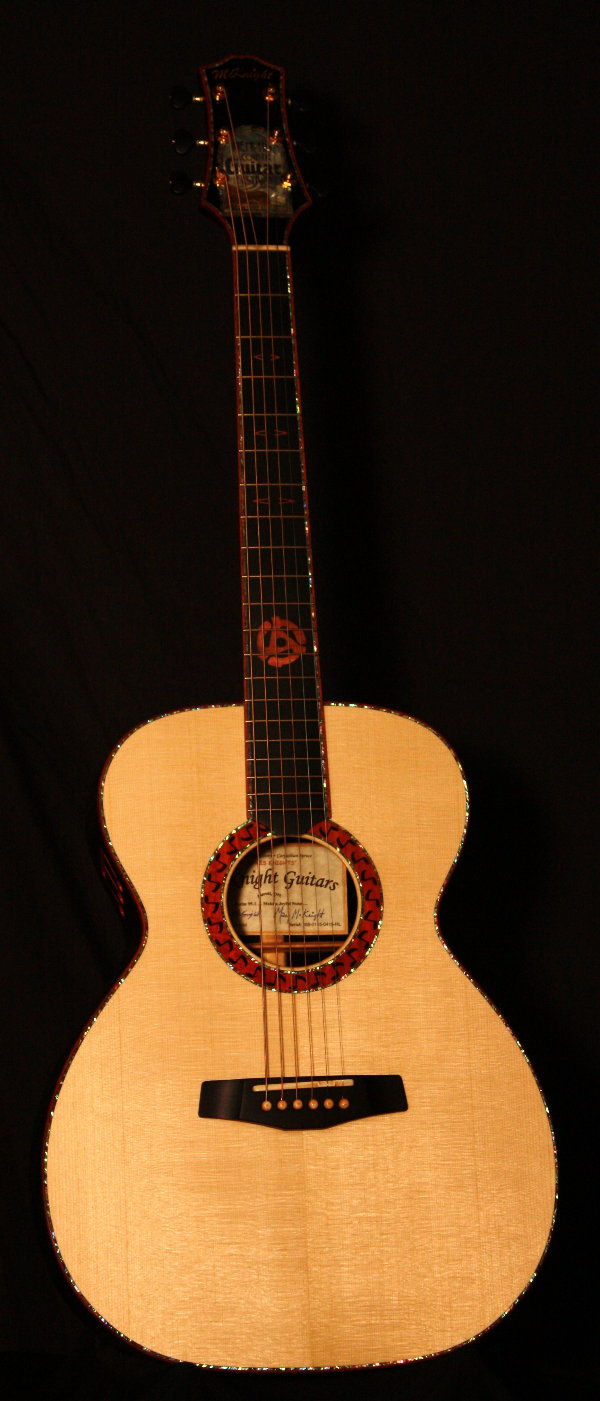
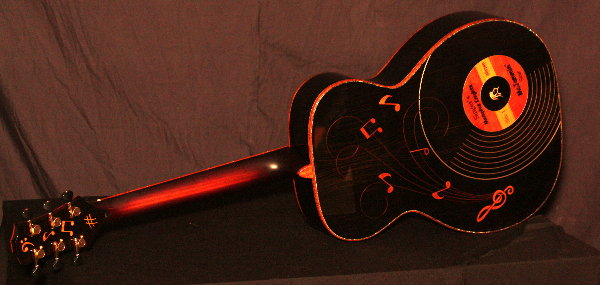
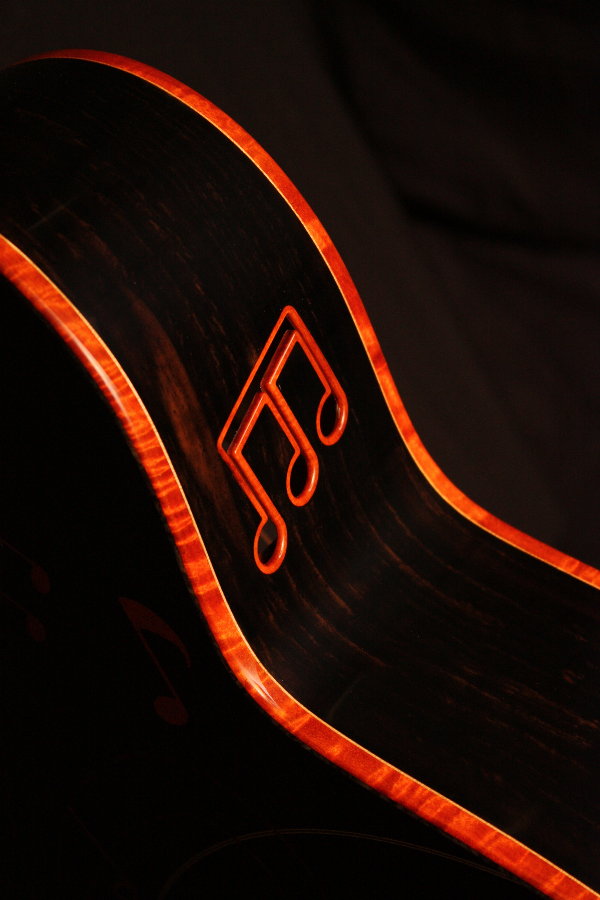
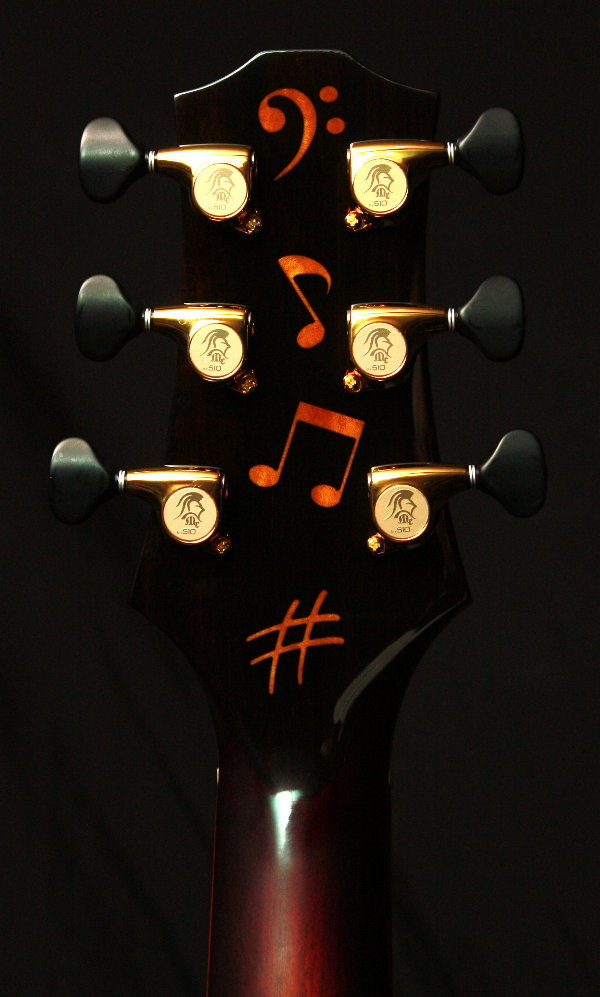
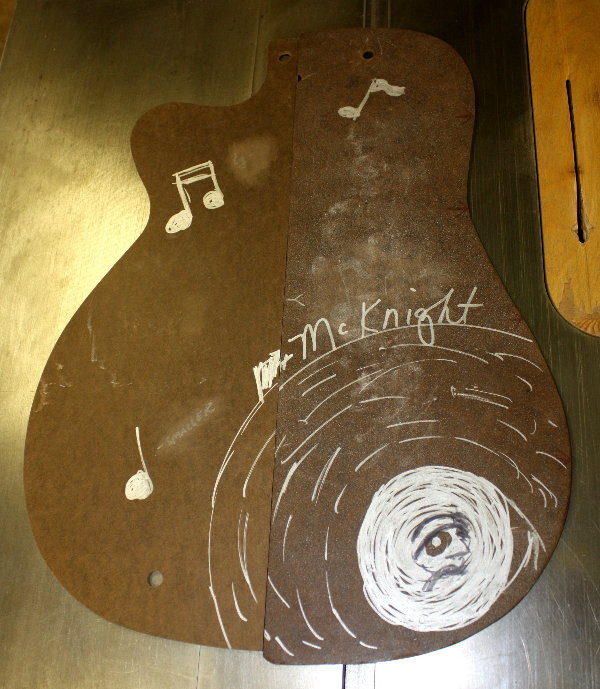
The Wheat Harvest Guitar was designed to honor American farming heritage. The SDG body back and sides are Honduran Mahogany from “The Tree” and topped with an Adirondack Red Spruce sound board. Bindings are Koa and inlay material is Pernambuco along with Ebony peg head, fingerboard and “pin less” bridge.